Key takeaways
- There is no recall of Federal Pioneer Stab-Lok panels in Canada. The panel itself has never been subject to a Canadian regulatory recall.
- Two narrow breaker recalls exist and are routinely misreported as panel recalls: NC015/NC015CP 15-amp breakers made between 1 August 1996 and 11 June 1997, and a 2010 voluntary recall of roughly 330 units with reversed ON/OFF handle markings.
- The well-known American failure-to-trip controversy concerns Federal Pacific in the United States. Federal Pioneer is a separate Canadian company, and Canadian regulators have not reached the same conclusions.
- We found no evidence that Canadian insurers refuse to cover these panels as a class. That claim circulates widely and we could not substantiate it — ask your own insurer rather than a contractor.
- The genuine limitation: no AFCI breakers are manufactured for these panels, which matters the moment you need to add a circuit that the Code now requires arc-fault protection on.
If you have a Federal Pioneer Stab-Lok panel in your basement, you have probably read that it has been
recalled, that it is a fire hazard, and that your insurer will drop you. Search the brand and you will find
that said with total confidence on dozens of pages.
The short version: there is no Canadian regulatory recall of Federal Pioneer Stab-Lok
panels. Two narrow, voluntary recalls of specific breakers exist, one from 1997 and one
from 2010, and both get stretched into claims they do not support. Schneider Electric still sells Stab-Lok
breakers new in Canada today. There is a real, practical limitation with these panels — but it is not
the one the internet talks about, and it is worth understanding properly before you spend several thousand
dollars.
What was actually recalled, and when
Two recalls exist in Canada. Both concern individual breakers, not panels.
The 1997 breaker recall
The Electrical Safety Authority issued a recall notice covering Federal Pioneer NC015 and
NC015CP 15-amp breakers manufactured between 1 August 1996 and 11 June 1997. The
defect was that the affected breakers might fail to trip on an overload. They are identifiable by a blue
handle with no hole in it — the compliant version of the same breaker has a hole in the handle.
That is a specific product, from a ten-month manufacturing window, nearly thirty years ago. It is not a
finding about Stab-Lok panels generally, and it is not a finding about every breaker that has ever gone into
one.
The 2010 breaker recall
In October 2010, Schneider Electric Canada voluntarily recalled a small batch of NA15, NA20, NB15 and
NB20 breakers — around 330 units — because the ON and OFF markings had been moulded onto the
handle the wrong way round. A breaker that reads OFF when it is actually ON is a genuine hazard to someone
working on the circuit, which is why it was pulled. It says nothing about whether the breaker protects the
circuit correctly.
We have seen this one reported in electrical trade press; we have not been able to confirm it
independently against a Health Canada listing, so treat the detail as trade-reported rather than
regulator-confirmed.
Why people think the panels were recalled
The confusion is understandable, and it comes from three places.
The American story is different from the Canadian one. In the United States, Federal
Pacific Electric — a different company from Federal Pioneer — was the subject of a long-running
controversy over Stab-Lok breakers failing to trip, including a US Consumer Product Safety Commission
investigation in the 1980s that closed without a recall, and later civil litigation in New Jersey. That is a
real and serious history. It is also an American one, involving an American manufacturer, and it has been
imported wholesale into Canadian conversation as though the two situations were identical.
Breaker recalls get reported as panel recalls. “Federal Pioneer recall” is a
much more shareable headline than “NC015 15-amp breakers from a 1996–97 production window”,
and the nuance disappears within about two repetitions.
It is commercially convenient. “Your panel has been recalled” is a very
effective way to sell a panel replacement. We would rather tell you what is actually true and let you decide
whether the work is worth doing.
For the avoidance of doubt: Schneider Electric continues to manufacture and sell Stab-Lok replacement
breakers in Canada. A product line under an active regulatory recall does not stay on the shelf.
The limitation that is real: no AFCI breakers
Here is the part that genuinely matters, and it almost never comes up in the recall conversation.
The Canadian Electrical Code has progressively expanded the requirement for arc-fault circuit
interrupter protection — AFCI — on residential circuits. An AFCI breaker detects the
signature of an arcing fault, the kind of low-current fault that a conventional breaker will happily ignore
and that starts fires in walls.
No AFCI breaker is manufactured in the Stab-Lok format. That means that the moment you need to add a
circuit that requires arc-fault protection — a bedroom circuit in a renovation, a finished basement,
most of what a modern addition needs — you cannot do it in that panel. The panel is not unsafe sitting
there; it is a dead end for anything new.
This is the honest argument for replacement, and it is a much better one than a recall that did not
happen. If you are planning a renovation, finishing a basement, adding an
EV charger or doing anything that adds
circuits, the panel’s format is going to constrain you. If you are not, and the panel is in sound condition,
there is no regulatory reason you must replace it.
What about insurance?
The claim that Canadian insurers refuse to cover homes with Federal Pioneer panels is repeated constantly.
We went looking for a source for it and could not find one. That is not the same as proving it never
happens — underwriting is done carrier by carrier and appetites change — but we are not prepared
to tell you it is a fact when we cannot evidence it.
What we would suggest instead: ask your own insurer or broker directly, and ask them specifically rather
than generally. The answer you get from your carrier about your policy is worth more than anything a
contractor or a blog tells you about the industry, including this one.
This is a different situation from knob-and-tube wiring, where insurer reluctance is well documented and
routinely determines whether a project goes ahead. We wrote about that separately in our
guide to knob-and-tube wiring in
Toronto.
What about Zinsco and Sylvania?
Zinsco comes up in the same conversations, usually in the same sentence. It is worth separating.
Zinsco was an American manufacturer, later absorbed into Sylvania, and the reliability concerns
associated with the brand are documented in the United States. We have not found Canadian regulatory
sourcing that establishes the same picture here, and Zinsco panels are far less common in Toronto housing
than Federal Pioneer, which was the dominant Canadian brand for decades. If you have been told you have a
Zinsco panel in a Toronto home, it is worth confirming the make first — the label is usually inside
the door.
How to assess your own panel sensibly
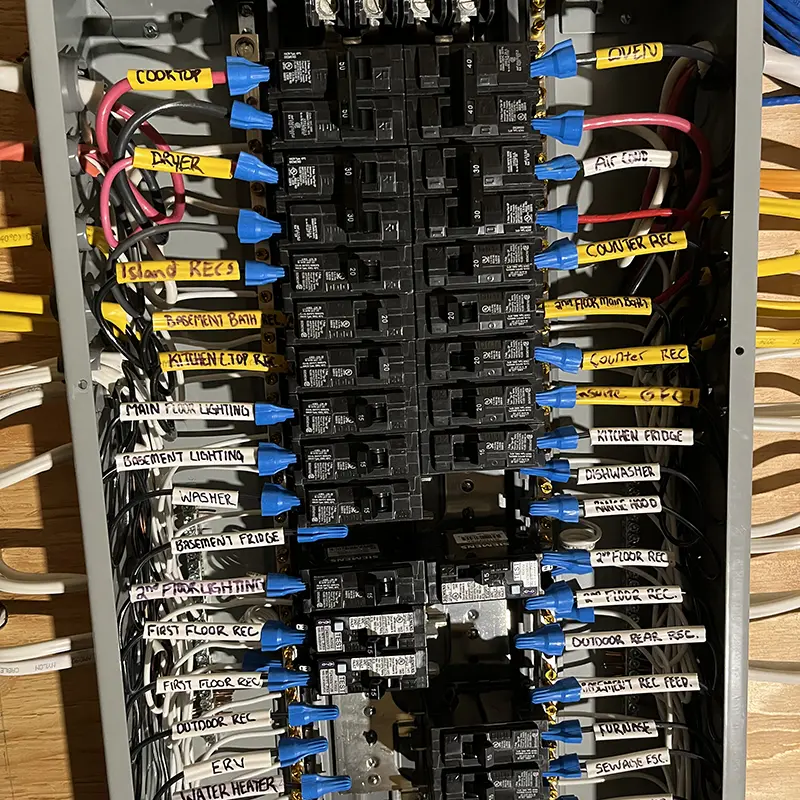
Regardless of brand, these are the things that actually indicate a panel needs attention:
- Heat. Warm breakers, a warm panel cover, or any discolouration or scorching around a
breaker is a reason to call someone now, not at your convenience. - Smell. A persistent acrid or “hot plastic” smell near the panel is an
emergency. - Breakers that will not reset, or that trip with no load change.
- Double-tapped breakers — two conductors under one terminal not rated for it.
- Corrosion, particularly in basements that have taken water.
- A full panel with no spare spaces, which is usually what brings the conversation to a
head anyway.
For the 1997 recall specifically: if your panel contains blue-handled 15-amp Federal Pioneer breakers
without a hole in the handle, have them identified and replaced. That is a cheap, targeted fix, and it is
the one action the recall actually calls for.
An electrical inspection will tell you
the panel’s make, its condition, whether it has been over-fused or double-tapped, and whether its capacity
supports what you are planning. That is a far better basis for a decision than the brand name on the door.
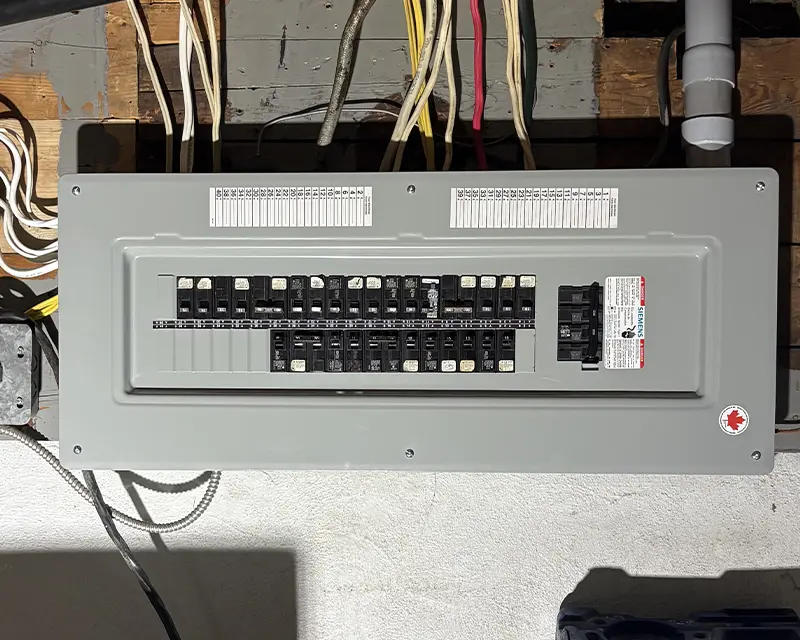
If you do decide to replace it
There are two quite different jobs here, and quotes for them are not comparable.
A like-for-like panel replacement puts a new panel in at the same service size, with the
utility connection untouched. We typically quote roughly $2,200–$3,800 at 100 amps and
$2,800–$4,500 at 200 amps, depending on circuit count and how the existing conductors
land. This is the right job when the service size genuinely still suits the house and you simply want a panel
you can buy modern breakers for.
A service upgrade replaces the service conductors, mast or underground feed, meter base
and panel, and involves the utility. For 100 amps to 200 amps we quote roughly
$4,000–$6,000 on an overhead service and $5,000–$7,500 where
the service is underground. Our panel upgrade cost guide breaks down
exactly what drives the difference.
Either way, the ESA notification filed by a licensed contractor for a panel or service change is $86,
against a $92 minimum notification fee — so a line item reading “ESA permit: $400” is
mostly administration, and you are entitled to ask what it covers.
We replace these panels across Toronto and the west GTA most weeks, usually as part of a renovation rather
than as an emergency. If you want a straight assessment of whether yours needs doing,
get in touch.
Frequently asked questions
Stab-Lok is the most expensive myth we correct, but not the only one. Here are twelve Ontario electrical myths, corrected, and the difference between a panel replacement and a service upgrade.
Are Federal Pioneer Stab-Lok panels recalled in Canada?
No. There is no Canadian regulatory recall of Federal Pioneer Stab-Lok panels. Two narrow voluntary recalls of specific breakers exist — NC015/NC015CP 15-amp breakers made between 1 August 1996 and 11 June 1997, and roughly 330 units recalled in 2010 for reversed ON/OFF handle markings. Schneider Electric still sells Stab-Lok breakers new in Canada.
Is a Federal Pioneer panel dangerous?
Not as a class, and not by virtue of the brand. What matters is the condition of the specific panel: signs of heat, scorching, corrosion, over-fusing or double-tapped terminals. The recalled 1997 breakers — blue handle, no hole — should be identified and replaced. Have the panel assessed on its condition rather than its label.
Why can’t I add AFCI breakers to a Stab-Lok panel?
No arc-fault breaker is manufactured in the Stab-Lok format. As the Canadian Electrical Code has expanded where AFCI protection is required, that makes the panel a dead end for new circuits — a bedroom circuit, a finished basement, most additions. It is the strongest practical reason to replace one, and it only bites when you need to add something.
Will my insurer cancel my policy over a Federal Pioneer panel?
We could not find evidence that Canadian insurers refuse these panels as a class, despite how often that is claimed. Underwriting varies by carrier and changes over time, so ask your own insurer or broker about your own policy. That is different from knob-and-tube wiring, where insurer reluctance is well documented.
How much does it cost to replace a Federal Pioneer panel?
A like-for-like panel replacement at the same service size typically runs roughly $2,200–$3,800 at 100 amps or $2,800–$4,500 at 200 amps. A full service upgrade from 100 to 200 amps, which involves the utility, runs roughly $4,000–$6,000 overhead and $5,000–$7,500 underground.
Is Federal Pioneer the same as Federal Pacific?
No. Federal Pacific Electric is an American manufacturer, and the well-known failure-to-trip controversy — including a US Consumer Product Safety Commission investigation that closed without a recall — concerns that company. Federal Pioneer is the Canadian company, later acquired by Schneider Electric. The two are routinely conflated online.
The 1997 recall is the Electrical Safety Authority’s notice covering Federal Pioneer NC015 and NC015CP breakers manufactured 1 August 1996 to 11 June 1997. The October 2010 Schneider Electric Canada recall is reported in Canadian electrical trade press and is described here as trade-reported rather than regulator-confirmed. Cost ranges reflect typical GTA market pricing together with our own quoting experience and are not a quotation. This article is general information, not a safety assessment of any particular installation.