Key takeaways
- A 1,500-watt space heater draws about 12.5 amps — close to the continuous limit of an ordinary 15-amp circuit.
- Tripping is usually overload: other things on the same circuit push it over. Use the low setting and give the heater its own circuit.
- A warm outlet or plug, a burning smell, or a breaker that trips instantly with only the heater on are warning signs, not nuisances.
- Never use a power bar or extension cord, and never fit a bigger breaker or fuse.
- For a room that is always cold, a hardwired heater on its own circuit or a heat pump is the permanent fix.
Every winter the same call comes in: the space heater in the bedroom, home office or basement keeps tripping the breaker. Sometimes it trips the moment the heater starts; sometimes it runs for an hour and then everything in the room goes dark. Homeowners reasonably assume something is wrong with the breaker.
Usually nothing is. The breaker is doing exactly what it is designed to do: protecting the wiring in your walls from carrying more current than it safely can. But a tripping breaker is also occasionally the first sign of a real fault, and the usual workarounds — a power bar, an extension cord to another room, a bigger breaker — range from ineffective to genuinely dangerous.
The short version: a typical 1,500-watt space heater draws about 12.5 amps, close to the limit of what an ordinary 15-amp circuit is meant to carry continuously. Add a computer, a lamp or a second heater on the same circuit and the breaker trips. Run the heater on its own circuit, on its low setting, plugged directly into the wall. If the outlet or plug gets warm, if you smell burning, or if the breaker trips with only the heater running, stop using it and have the circuit checked.
The arithmetic behind the trip
Most space heaters sold in Canada are rated at 1,500 watts on high. At 120 volts, that is 12.5 amps.
Most receptacle circuits in a house are 15-amp circuits. The breaker will carry 15 amps, but the Code limits continuous loads — anything running for hours at a time — to 80 percent of the breaker’s rating, which on a 15-amp circuit is 12 amps. A space heater on high is a continuous load that already sits at or above that line on its own.
Now look at what else is on the circuit. Bedrooms in many houses share one circuit between two or three rooms. That circuit might also feed a computer, a monitor, a lamp, a phone charger, a television and, in some older houses, the hallway lights. Each one adds a little current. The total crosses 15 amps, the breaker heats up internally over a few minutes or an hour, and it trips.
That delay is why the trip often seems random. A breaker does not trip the instant it sees 15.5 amps; it trips faster the further over the limit the circuit is, and slower when it is only slightly over. A heater that runs for forty minutes before the lights go out is a circuit that is only slightly overloaded, for a long time.

When tripping is normal, and when it is a warning
A breaker tripping under a heavy load is protection working. But some patterns point to a problem in the wiring or the device rather than simple overload.
Probably just overload:
- The breaker trips after the heater has been running a while, and only when other things on the same circuit are on.
- Running the heater on low, or moving it to another room, stops the tripping.
- The breaker resets normally and nothing is warm.
Worth having checked within days:
- The receptacle, cover plate or plug is warm or discoloured. A heater draws enough current to expose a loose or worn connection, and loose connections make heat inside the wall.
- The breaker trips immediately when the heater starts, even with nothing else running.
- An AFCI breaker trips repeatedly on this circuit — arcing faults are exactly what it is built to catch. See GFCI vs AFCI.
- Lights elsewhere in the house dim noticeably whenever the heater cycles on.
Stop using it and call now:
- A burning or hot-plastic smell, scorch marks, melting or sparking at the outlet or plug.
- A breaker or fuse that will not reset, or resets and trips again instantly.
Our guide to telling an electrical emergency from a nuisance covers these in more detail.
What never to do about it
Every one of these is common, and every one makes the situation worse.
- Do not plug a space heater into a power bar or an extension cord. Most power bars and household cords are not built to carry a heater’s current for hours. They overheat, and a power bar’s own switch is not a substitute for the breaker. Heater manufacturers and the Electrical Safety Authority both say the same thing: plug it directly into the wall.
- Do not run an extension cord to another room to reach a different circuit. That moves the load without fixing anything, adds a cord that can overheat, and creates a trip hazard across a doorway.
- Do not replace the breaker with a bigger one. A 20-amp breaker on wiring sized for 15 amps removes the protection entirely; the wire in the wall can now overheat without the breaker ever tripping. In older homes with fuses, fitting a larger fuse does exactly the same thing — and because a larger fuse physically fits, it is one of the most common dangerous findings in Toronto inspections.
- Do not keep resetting it. Each reset into an overload or a fault adds heat. If it trips twice, find out why.
Quick fixes that actually work
If the cause is simple overload, these solve it without any electrical work:
- Use the low setting. Most heaters have a 750-watt setting that draws about half the current. In a small, closed room it is often enough.
- Give the heater its own circuit. Turn off everything else on that circuit, or move the heater to a receptacle on a different circuit. A labelled panel makes this easy; an unlabelled one turns it into guesswork.
- Do not run two heaters on one circuit. Two 1,500-watt heaters on a 15-amp circuit will always trip it.
- Keep the room closed and draught-proofed so the heater cycles less.
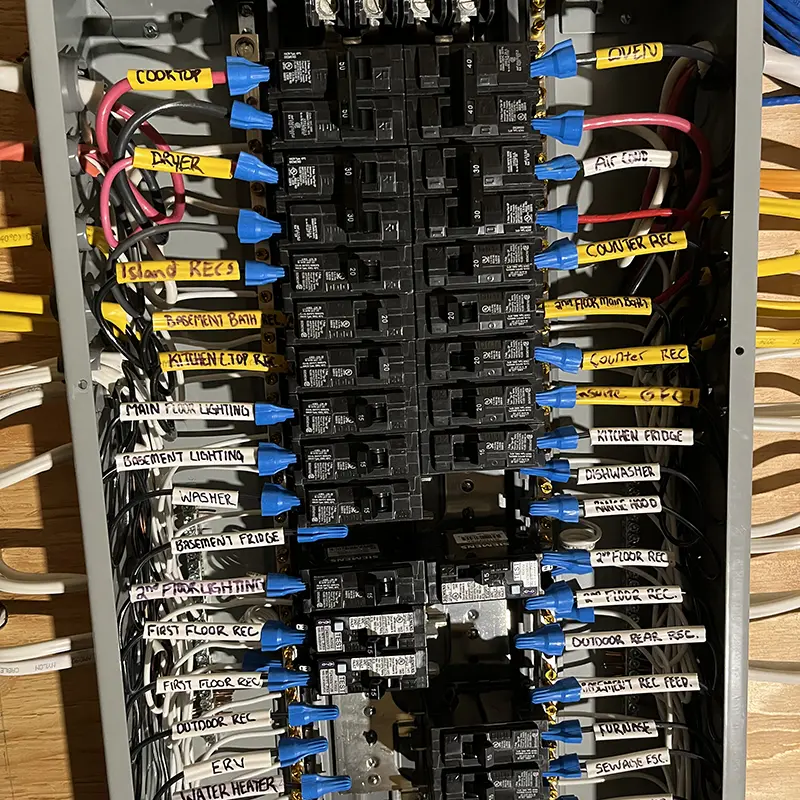
If you do not know which receptacles share a circuit, switch off one breaker at a time and see what goes dark. Or have an electrician map the panel properly — it is a small job, and it pays for itself the first time something trips at night.
Permanent fixes for a cold room
A space heater running every evening is a symptom. The room is cold for a reason, and the permanent fixes are better than a plug-in heater on every count — safety, comfort and running cost.
- A dedicated circuit for the heater. If the room genuinely needs supplementary heat, a dedicated 120-volt circuit to one receptacle ends the tripping. It is a modest job when there is space in the panel and a reasonable route.
- A hardwired heater on its own 240-volt circuit. Baseboard heaters, wall-mounted fan heaters and in-floor electric heat run on 240-volt dedicated circuits, are controlled by a thermostat, and do not compete with anything else in the room. In a basement office or an addition, this is usually the right answer.
- Fix the heating system. A room that is always colder than the rest of the house often has a ductwork, balancing or insulation problem. A heating contractor can tell you whether that is the real issue.
- A heat pump. A ductless mini-split heat pump heats and cools a problem room efficiently. It needs its own circuit, and on an older service the load calculation decides whether the panel can carry it — our heat pump panel guide explains how to check.
For whole-house context on what your panel can carry, see 100-amp vs 200-amp service.
Older Toronto houses: a special case
In older houses the same symptoms deserve more caution, for three reasons.
Fuse panels. If your house still has fuses, check the ratings. A 20- or 30-amp fuse protecting a circuit wired for 15 amps is a serious hazard that a space heater exposes immediately: the fuse does not blow, and the wiring overheats instead. Fuse panels are legal in Ontario homes, but over-fusing is not. See fuse box vs breaker panel.
Knob-and-tube wiring. Original knob-and-tube circuits were designed for the loads of the 1920s, rely on open air around the conductors to shed heat, and have often had decades of alterations. A space heater on one of them is a heavy load on an old system. Our guide to knob-and-tube wiring explains what the ESA actually requires.
Aluminum branch wiring. In many 1960s and 70s houses, the weak point is the connection at the receptacle. A heater’s sustained current is exactly what makes an improper aluminum connection heat up. If your outlets are warm and the house was built in that era, see aluminum wiring in Ontario.
When to call an electrician
Call us, or any licensed electrician, if:
- A receptacle, plug or cover plate gets warm, discolours or smells.
- The breaker trips with only the heater running, or trips instantly.
- An AFCI breaker keeps tripping on the same circuit.
- You have fuses and are not sure the ratings are correct.
- You want a dedicated circuit or a hardwired heater for a room that is always cold.
Our electrical repair team traces trips to the cause on the circuit rather than swapping parts, and we cover Toronto, York, East York, Etobicoke and the rest of the west GTA.
Frequently asked questions
Why does my space heater trip the breaker?
A 1,500-watt heater draws about 12.5 amps, close to the continuous limit of a 15-amp circuit. Anything else on the same circuit — a computer, lamps, another heater — pushes the total over 15 amps and the breaker trips. That is the breaker protecting the wiring, not a faulty breaker.
Can I plug a space heater into a power bar?
No. Most power bars and extension cords are not designed to carry a heater’s current for hours and can overheat. Plug a space heater directly into a wall receptacle, and do not share that circuit with other heavy loads.
Should I replace my 15-amp breaker with a 20-amp one?
Never, unless the circuit is wired for 20 amps. A larger breaker on wiring sized for 15 amps removes the protection, so the wiring can overheat inside the wall without the breaker tripping. The same applies to fitting a larger fuse.
Is it dangerous if the outlet gets warm with a space heater plugged in?
Yes. A warm receptacle, plug or cover plate usually means a loose or deteriorating connection, which can overheat inside the wall. Stop using that outlet and have it checked by a licensed electrician.
How many space heaters can I run on one circuit?
One, on a typical 15-amp circuit, and preferably with little else running. Two 1,500-watt heaters will always overload a 15-amp circuit.
What is a better alternative to a space heater?
For a room that is always cold, a hardwired baseboard or wall heater on its own 240-volt circuit, a ductless heat pump, or fixing the underlying heating or insulation problem. Each is safer and more comfortable than a plug-in heater running every evening.
Current figures are calculated from the heater rating (watts divided by 120 volts). The 80 percent continuous-load limit is a general Canadian Electrical Code principle; specific requirements depend on the installation. Always follow your heater manufacturer’s instructions.