
Home » Panel Replacement vs Service Upgrade
Panel Replacement vs Service Upgrade
Home » Panel Replacement vs Service Upgrade
Panel Replacement vs Service Upgrade
Compare
They are quoted as if they were the same job. One replaces the box on the wall; the other changes how much power your house can draw — and involves a lot more.
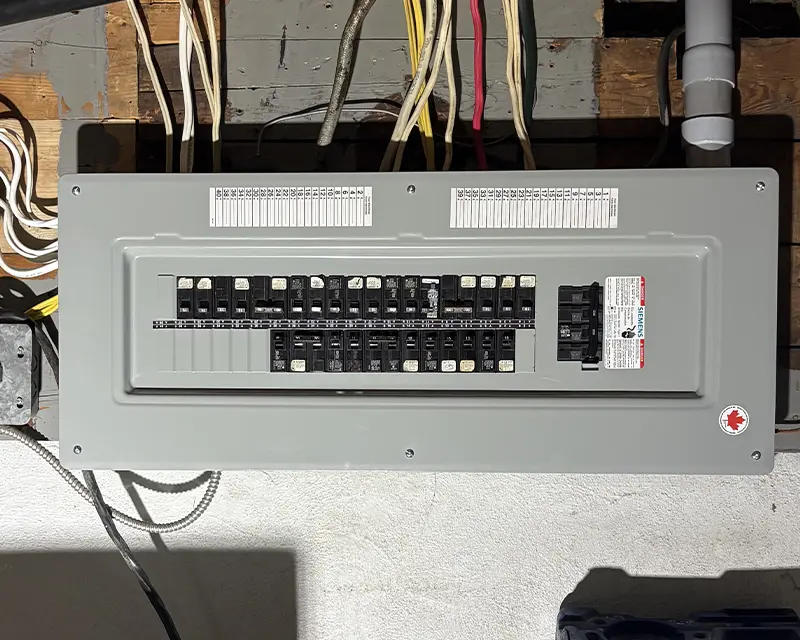
A panel replacement swaps an old panel for a new one of the same capacity — same service size, same supply from the utility. A service upgrade increases that capacity, typically from 60 or 100 amps to 200, and that means replacing more than the panel: the conductors from the utility, often the meter base and mast, and the grounding.
Knowing which one a quote describes is the single most useful thing you can do when comparing quotes — because two prices for “a new panel” are often prices for two different jobs.
| Panel replacement | Service upgrade | |
|---|---|---|
| What changes | The panel and its breakers | The panel, service conductors, usually the meter base and mast, and grounding |
| Capacity afterwards | The same as before | Higher — commonly 200 amps |
| Why it is done | Condition: damage, no spare spaces, a fuse panel, an insurer's requirement | Capacity: the calculated load exceeds what the service can carry |
| Utility involvement | A disconnect and reconnect so the work can be done safely | A disconnect and reconnect, plus utility requirements for the new service |
| Indoor meters | Usually unaffected | Typically relocated outdoors on upgrade |
| ESA notification | Yes | Yes |
| Typical duration on site | Usually a single day | Usually a day on site, after weeks of utility scheduling |

If the house has enough capacity but the panel itself is the problem, replace the panel and leave the service alone. Typical reasons: a fuse panel you want to retire, a breaker panel with no spaces left, visible damage or overheating, a format with limited breaker options, or an insurer that will not cover the existing equipment.
The calculated load decides whether that is enough. If it shows the house is comfortable on its existing service, an upgrade adds cost without adding anything you will use.
A service upgrade is about capacity. The usual triggers are an EV charger, a heat pump, electric cooking and hot water together, a basement suite, or a major addition — anything that pushes the calculated load past what the service carries. See 100-amp vs 200-amp service for how that calculation works.
Because the service conductors and metering change, the utility is more involved, and its rules can shape the job: Toronto Hydro caps overhead residential services at 200 amps, and Oakville Hydro requires new and replaced services to go underground.
On either job, the electrical work itself is usually done in a day. What takes time is the sequence around it: the ESA notification, the utility’s disconnect booking, the inspection, and the reconnection. For a service upgrade in Toronto Hydro territory, that scheduling commonly runs to several weeks.
Our step-by-step guide to the Toronto Hydro upgrade process sets out each stage and who controls it.
A panel replacement swaps the panel for a new one with the same capacity. A service upgrade increases the capacity the home can draw from the utility, which usually means replacing the service conductors, meter base and grounding as well as the panel.
No. If your existing service has enough capacity for your calculated load, the panel can be replaced on its own. An upgrade is only needed when the load requires more capacity.
Usually, yes. The utility disconnects the supply so the panel can be replaced safely, then reconnects once the work is authorised. A service upgrade involves the utility more heavily because the service itself changes.
The work on site is usually a day. The overall timeline is set by utility scheduling and inspections, which in Toronto Hydro territory commonly takes several weeks from booking to reconnection.
Check whether each quote is for a panel replacement or a service upgrade, what amperage it delivers, whether the meter base and mast are included, and whether ESA and utility coordination are covered. Like-for-like comparison usually explains most of the price difference.
What each job typically costs, and what moves the number.
Read more →Every step from load calculation to reconnection.
Read more →When an older panel genuinely needs replacing — and when it does not.
Read more →Related services: Panel & Service Upgrades · EV Charger Installation · Basement Suite Wiring.
Tell us what the house has and what you are planning. We will give you a straight answer.