Key takeaways
- Toronto Hydro’s published Standard Service Charges to isolate a residential service are $120 at the meter or $300 at the pole in regular hours — $400 and $820 respectively after hours.
- The widely quoted $678 ‘Toronto Hydro fee’ is a myth. It traces to a 2023 forum post and does not appear in Toronto Hydro’s published charges.
- Overhead residential services in Toronto are capped at 200 amps. Anything larger has to go underground, and the customer pays the civil work.
- If your meter is indoors, it has to move outside as part of the upgrade — a frequent surprise on older Toronto houses.
- Plan for roughly a month of utility lead time on the isolation. It is usually the longest single item in the schedule, and it is the one your contractor controls least.
Upgrading your electrical service in Toronto involves three organisations that do not report to each
other: your electrical contractor, the Electrical Safety Authority, and Toronto Hydro. Most of the
frustration homeowners describe — the vague timelines, the surprise charges, the job that stalls for
weeks — comes from not knowing which of the three is holding things up, or why.
The short version: your contractor does the work and files with the ESA; the ESA inspects
and authorises; Toronto Hydro disconnects and reconnects. The utility’s published charge to isolate your
service is $120 at the meter or $300 at the pole during regular hours. The
$678 figure circulating on Toronto forums is not a Toronto Hydro charge and appears nowhere in their
Conditions of Service.
Who does what: the three organisations involved
Your electrical contractor designs the service, does the physical work, and files the
notification with the ESA under their own licence. They also coordinate with the utility on your behalf. A
licensed contractor — ours is ECRA/ESA 7014949 — is legally required for this work; it is not
homeowner-permit territory.
The Electrical Safety Authority is the regulator. In Ontario there is no municipal
electrical permit for this work: you file a notification with the ESA, an inspector attends, and the ESA
issues the authorisation the utility needs before it will energise anything. The published residential fee
for a service or panel change filed by a licensed contractor is $86, against a $92 minimum notification
fee.
Toronto Hydro owns everything up to and including the meter. They disconnect the service
so the work can be done safely, and they reconnect and energise it afterwards — but only once the ESA
has authorised. They do not inspect your wiring and they do not take instructions from you about the
schedule.
The single most useful thing to understand is that the utility acts on the ESA’s authorisation, not on
your contractor’s word. That is why the order of operations is rigid, and why a failed inspection does not
just cost a re-inspection fee — it costs your place in the utility’s queue.

What Toronto Hydro actually charges
These are published Standard Service Charges, not negotiated numbers:
- Isolation at the meter: $120 during regular hours, $400 after hours.
- Isolation at the pole or overhead transformer: $300 during regular hours, $820 after
hours. - A residential disconnection requested by the customer: no charge.
Which one applies depends on where the service can be safely de-energised, and that is determined by the
configuration at your house rather than by preference. After-hours work costs more for the obvious reason,
and is occasionally unavoidable on a street where a daytime outage would affect other customers.
The $678 myth
A figure of $678 gets quoted constantly as “the Toronto Hydro fee” for a service upgrade. We
went looking for it. It does not appear in Toronto Hydro’s Conditions of Service or in their published
schedule of standard charges. As far as we can trace it, it originates in a late-2023 post on a Canadian
deals forum and has been repeated ever since, including by contractors who ought to check.
We mention it partly because we published it ourselves once, before checking it properly, and corrected
it. If a quote you are holding contains a $678 utility line, ask what it is for — it may be a genuine
bundle of contractor coordination time, but it is not a Toronto Hydro tariff.
The sequence, and how long each step takes
A typical residential service upgrade in Toronto runs like this:
- Site assessment and load calculation. Establishes what service size the house actually
needs. Same day. - Quote and contract. Under Ontario’s consumer protection rules a contract over $50 must
be written and must itemise materials, warranties, the work schedule, sub-trades, the payment schedule and
who prepares and cleans the work area. - ESA notification filed by the contractor, and a service layout request submitted to
Toronto Hydro. This is where the clock starts. - Toronto Hydro reviews and schedules the isolation. This is the long pole — allow
roughly a month. It can be faster; it is frequently not. - Disconnect and install. The utility isolates the service; the contractor replaces the
service entrance, mast or underground feed, meter base and panel, and transfers the circuits. On a standard
residential job this is typically one day, occasionally two. - ESA inspection. The inspector attends and, if satisfied, issues the authorisation.
- Toronto Hydro reconnects and energises.
Start to finish, six to eight weeks is a realistic expectation, with the great majority of that being
utility scheduling rather than work in your house. Anyone promising a two-week turnaround is describing the
labour, not the process.
One cost worth avoiding: if the site is not ready when the ESA inspector arrives, there is a $177 charge.
It is a small but real argument for using a contractor who schedules their own inspections properly.
Overhead, underground, and the 200-amp ceiling
Toronto Hydro caps overhead residential services at 200 amps. If your house needs more
than that — a large home with electric heat, a substantial addition, a multiplex conversion — the
service has to be underground, and the customer pays for the civil work: trenching, conduit, restoration of
whatever the trench crosses.
That is the single biggest fork in the cost of a service upgrade, and it is why the honest answer to
“what does a service upgrade cost” is a range rather than a number. For 100 amps to 200 amps we
typically quote roughly $4,000–$6,000 on an overhead service and
$5,000–$7,500 where the service is underground. Our
panel upgrade cost guide breaks
down what moves within those ranges.
There is a further constraint that catches deep lots: if the run from the connection point is long enough
that voltage drop exceeds allowable limits, the solution may involve a primary line extension, which is a
different order of project entirely. This is uncommon but not rare on large properties, and it is worth
identifying at the assessment stage rather than after a trench is open.
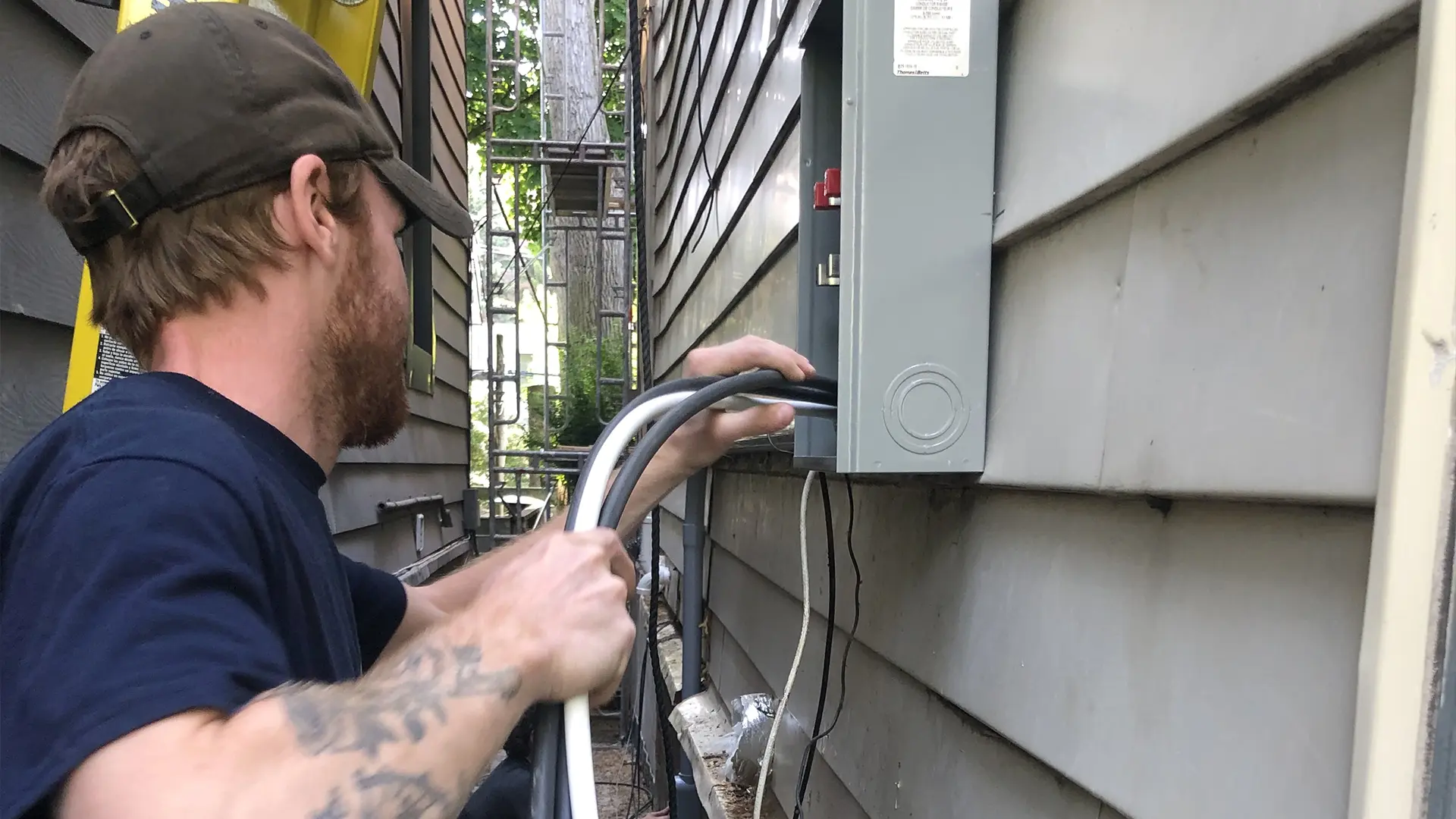
Indoor meters have to move
Plenty of older Toronto houses still have the meter inside — in a basement, a vestibule, sometimes a
closet. On a service upgrade it has to be relocated outdoors. This is a common surprise, because homeowners
reasonably assume the meter stays where it is, and it adds exterior work, a new meter base location and
often patching to the plan.
What changed in 2025, and why old quotes do not compare
If you are comparing a quote you got a couple of years ago against one you have now, part of the
difference is a genuine change in what the Code requires rather than pure price inflation.
The rewrite of Section 10 of the Code changed how bonding and grounding are handled at the service. The
principle is that the neutral is grounded at one location only. In practical terms, ESA
stopped accepting meter-base bonding through the neutral in October 2025. A service entrance
built to the current requirement legitimately involves work that a 2023 installation did not.
This matters when you are weighing two quotes that are far apart. A cheaper quote is sometimes a better
price; it is sometimes an installer who has not updated their detail. Asking how they are handling service
bonding under the current Section 10 requirements is a fair and revealing question.
Material costs are a smaller factor than people assume. Raw copper rose sharply through 2026, but
Canadian finished wire and cable rose far less, and Statistics Canada’s construction price data puts
installed residential electrical work in Toronto up only modestly year over year. The spread between two
quotes is nearly always scope, not copper.
Outside Toronto: Alectra and Oakville Hydro
Toronto Hydro’s rules stop at the city boundary, and the differences are worth knowing if you are in the
west GTA.
Alectra Utilities serves Mississauga and Vaughan. Their residential customers are
generally entitled to one free isolation and re-energisation per year, which removes the utility
disconnection charge from the equation entirely for most service upgrades. That is a real and rarely
mentioned difference from Toronto.
Oakville Hydro is the strictest of the three on configuration: all new and replaced
services go underground, regardless of size. There is no overhead option to fall back on, so
the civil work is part of every service upgrade rather than a threshold you cross at 200 amps. Indoor meters
must be relocated outside on upgrade, as in Toronto, and Oakville applies a rule stricter than the provincial
Code in prohibiting conductors above pools.
We work across all three utility territories — see our
Oakville,
Mississauga and
Vaughan panel upgrade
pages for how the local rules change the job.
What delays a service upgrade
In rough order of how often we see them:
- Utility scheduling. The dominant factor, and largely outside anyone’s control. File
early. - A failed ESA inspection, which costs both the re-inspection and the utility slot.
- Unexpected meter relocation discovered late, when an indoor meter was not identified at
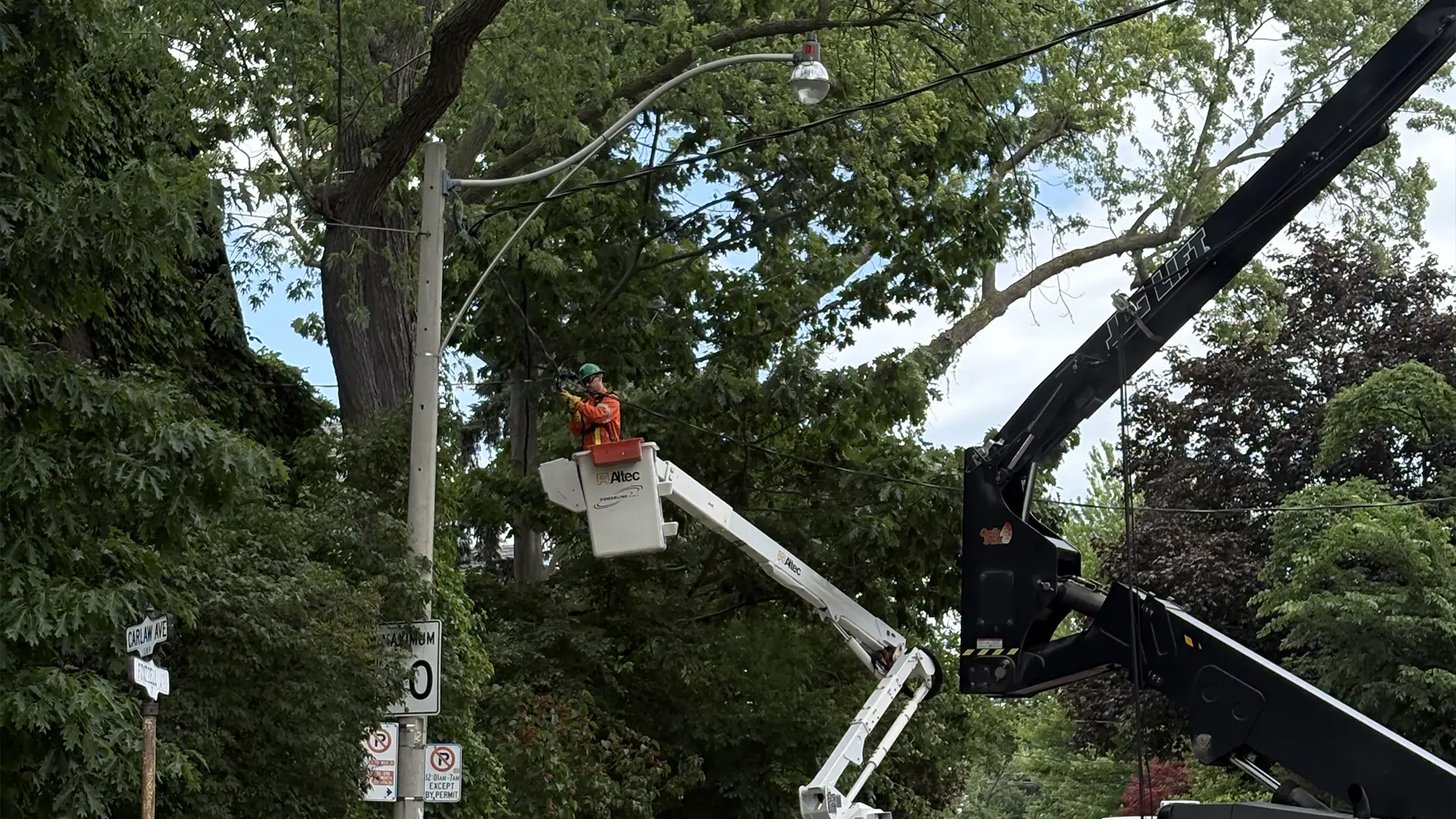
assessment. - Tree clearance around an overhead service drop, which sometimes has to be resolved
before the utility will attend. - Access. The crew needs working room at the service entrance; a deck, an addition or a
heavily planted side yard can complicate it. - Weather, for overhead work specifically.
Most of these are identifiable at the assessment stage by someone who has done this in Toronto before.
That is the main argument for having the site looked at properly before a quote is issued, rather than
priced off a photo of your panel.
If you are planning an upgrade — whether for an
EV charger, a heat pump, a
renovation or simply because the fuse box has run out of road — our
Toronto panel upgrade page
covers how we handle it, or get in touch and we will
walk the service with you.
Frequently asked questions
How much does Toronto Hydro charge to disconnect power for a service upgrade?
Toronto Hydro’s published Standard Service Charges are $120 to isolate at the meter and $300 to isolate at the pole or overhead transformer during regular hours, rising to $400 and $820 after hours. A residential disconnection requested by the customer carries no charge. The $678 figure widely quoted online is not a Toronto Hydro charge.
How long does a service upgrade take in Toronto?
Six to eight weeks end to end is realistic, of which the great majority is Toronto Hydro scheduling the isolation — allow roughly a month for that alone. The physical work at your house is typically one day, occasionally two. Anyone quoting a two-week turnaround is describing the labour rather than the process.
Do I need a permit for a service upgrade in Ontario?
You need an ESA notification, not a municipal electrical permit — electrical work in Ontario is regulated by the Electrical Safety Authority. A licensed contractor files it under their licence. The published fee for a service or panel change is $86, against a $92 minimum notification fee. Toronto Hydro will not energise the service until the ESA has authorised it.
Can I get more than 200 amps on an overhead service in Toronto?
No. Toronto Hydro caps overhead residential services at 200 amps. Anything larger must be supplied underground, and the customer pays for the civil work including trenching, conduit and restoration. That threshold is the biggest single fork in the cost of a service upgrade.
Does my electrical meter have to move outside?
If it is currently indoors, yes — an indoor meter must be relocated outdoors as part of a service upgrade. This catches out a lot of owners of older Toronto homes, because it adds exterior work, a new meter base position and usually some patching that was not in the original mental picture of the job.
Why is my 2026 quote higher than the one I got in 2023?
Partly genuine Code change. The Section 10 rewrite means the neutral is grounded at one location only, and ESA stopped accepting meter-base bonding through the neutral in October 2025, so a current service entrance involves work an older one did not. Material inflation is a smaller factor than most people assume — the gap between two quotes is nearly always scope.
Utility charges are Toronto Hydro’s published Standard Service Charges; ESA fees are the Electrical Safety Authority’s published residential rates effective April 1, 2026. Alectra and Oakville Hydro practices reflect those utilities’ published conditions of service. Cost ranges reflect typical GTA market pricing together with our own quoting experience and are not a quotation. Utility charges and lead times change — confirm current figures with your utility.