
Home » Fuse Box vs Breaker Panel
Fuse Box vs Breaker Panel
Home » Fuse Box vs Breaker Panel
Fuse Box vs Breaker Panel
Compare
Fuse panels remain legal in owner-occupied Ontario homes. The reasons to replace one are real — they are just not the ones usually given.
Being told your fuse panel is illegal, or that it has been condemned, is the usual opening of a sales conversation. Neither is true. Fuse panels remain legal in owner-occupied homes in Ontario and there is no requirement to replace one. The genuine arguments for replacing yours are different, and worth understanding on their own terms.
| Fuse panel | Breaker panel | |
|---|---|---|
| How it protects | A metal element melts, breaking the circuit. Single use. | A mechanical switch trips and is reset by hand. |
| After a fault | The fuse is replaced — and a fuse of the correct rating must be to hand | The breaker is reset in seconds |
| Legal in Ontario | Yes, in owner-occupied homes | Yes |
| Over-fusing risk | High — a larger fuse physically fits and removes the protection | Low — a larger breaker is a deliberate act with the cover off |
| AFCI / GFCI breakers | Not available | Available, and required for new circuits in many locations |
| Adding circuits | Generally not practical | Straightforward while spaces remain |
| Typical service size | Usually 60 amps, occasionally 100 | 100 or 200 amps |
| Insurance view | Varies by carrier; some take a view | Generally unremarkable |
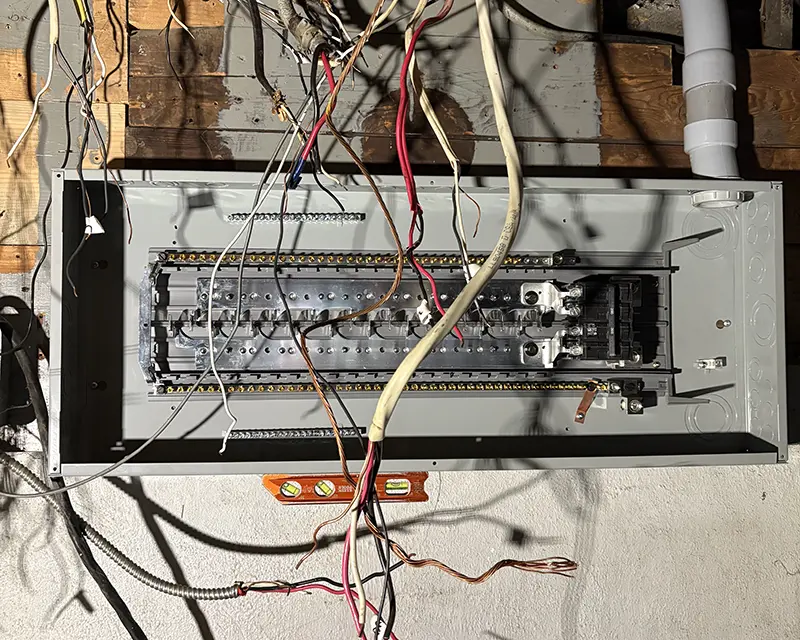
The defect we find most often in fuse panels is a 20- or 30-amp fuse in a socket feeding wiring rated for 15. It usually happens because the 15 kept blowing and someone decided a bigger fuse was the solution. It is not: the fuse is the only overcurrent protection those conductors have, and replacing it with a larger one removes the protection while leaving the appearance of it.
A breaker panel makes this much harder to do by accident. That is the strongest safety argument for switching, and it is a genuine one.
The Code now requires arc-fault protection on a growing list of residential circuits, and ground-fault protection near water. Neither is available in a fuse format. The moment you want to finish a basement, add a bedroom circuit, wire a second suite or install an EV charger, the panel is a dead end.
For most homeowners this is what actually forces the decision — not a safety scare, but a renovation that cannot proceed.
There are two quite different jobs here and quotes for them are not comparable. A like-for-like panel replacement swaps the panel at the same service size without involving the utility. A service upgrade replaces the service conductors, mast or underground feed, meter base and panel, and requires the utility to disconnect and reconnect.
Because most fuse panels sit on 60-amp services, the second is usually what is actually needed. Our panel upgrade page covers how we handle it, and the cost guide breaks down what moves the number.
No. Fuse panels remain legal in owner-occupied homes and there is no requirement to replace one. The practical problems are over-fusing, the inability to fit AFCI or GFCI protection, and the difficulty of adding circuits — not legality.
Not inherently. A correctly fused panel in sound condition protects a circuit perfectly well. The risk is over-fusing — a larger fuse physically fits and silently removes the protection. If your panel has fuses larger than 15 amps on lighting and receptacle circuits, that is worth addressing now.
It varies by carrier, and some take a view. This is different from knob-and-tube wiring, where insurer reluctance is well documented. Ask your own insurer or broker about your own policy rather than relying on a general claim.
Not as an add-on in the way people usually mean. You can install a sub-panel fed from an adequate service, which gives you breaker-protected circuits for an addition. But if the underlying service is 60 amps, the sub-panel does not create capacity that is not there — the service is the constraint.
The changeover itself is typically a single working day. Where the service size is also changing, the utility must schedule an isolation, and that wait — measured in weeks in Toronto — is the longest part of the project.
Like-for-like swap versus full service upgrade, and what drives each.
Read more →Fuse panels and knob-and-tube often travel together in older homes.
Read more →What different jobs cost and what the ESA portion of a quote covers.
Read more →Related services: Panel & Service Upgrades · Home Rewiring · 100A vs 200A Service.
Tell us what the house has and what you are planning. We will give you a straight answer.