The short version: Licensed electricians in Toronto generally run $95–$150 an hour in 2026, most charge a service call minimum of roughly $150–$250 including the first hour, and the ESA fee on your quote should be about $92 — anything well above that is contractor administration, not the regulator.
Search “how much does an electrician cost in Toronto” and you’ll find aggregator pages quoting national averages, at least one guide whose “2026” figures are actually from October 2020, and very little from actual electricians. Which is how people end up asking on forums whether $250 for an outlet is reasonable and getting five answers spanning a 400% range.
Here’s the honest version from a licensed contractor: how the pricing is built, what the real regulated fees are, and roughly what things cost.
Hourly rates in 2026
Published Canadian cost data puts licensed electricians in the range of $80 to $150 an hour, with Toronto generally in the upper half at roughly $95 to $150. By licence level:
- Apprentice: roughly $60–$80/hr
- Journeyperson: roughly $80–$130/hr
- Master electrician: roughly $100–$160/hr
The rate you’re quoted isn’t the electrician’s wage. Out of it come the wage, WSIB, liability insurance, ECRA/ESA licensing, vehicle and fuel, a van stocked so a second trip isn’t needed, ESA filing administration, and the office time that schedules and documents the job. An unlicensed operator with none of that costs less — and that gap is exactly what you’re paying for when something goes wrong. Materials typically carry a 15–25% markup, and labour is usually 60–80% of a residential bill.
Why the small job costs more than you’d think
The most common frustration we hear is “it took fifteen minutes and cost $200.”
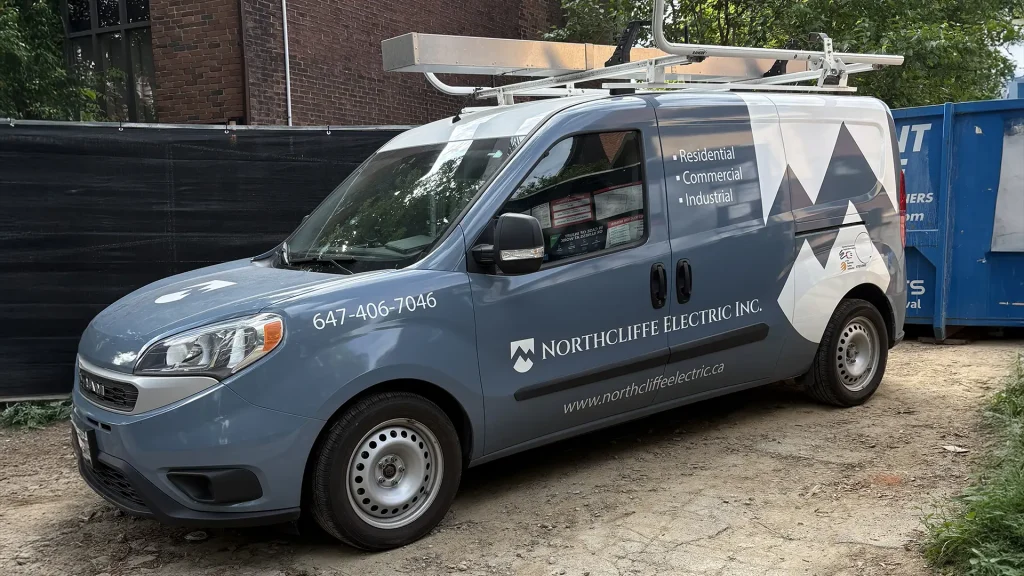
Published data puts a Toronto service call minimum at roughly $150 to $250 including the first hour, or a trip fee of about $75 to $150 plus labour. That covers the drive across the city both ways, the stocked van, and the block of a licensed tradesperson’s day that your visit occupies — not just the minutes with a screwdriver in hand.
The practical takeaway is simple: bundle. A dead outlet, a fixture swap, a dimmer that never worked and a dead outdoor receptacle done in one visit cost roughly one minimum. Done across four visits, they cost four.
The ESA fee — check this line on every quote
Most electrical work in Ontario must be filed with the Electrical Safety Authority. From ESA’s 2026 residential fee schedule, effective April 1, 2026:
- Minimum notification fee: $92
- Service or panel change (licensed contractor): $86
- EV charger: $86 plus $30
- Additions or alterations without service work: from $46 (1–10 outlets)
- Pool or hot tub: $168
So when a quote shows “ESA permit — $400,” roughly $92 of that is the regulator and about $300 is the contractor’s administration. That can be an entirely fair charge — someone files the notification, schedules the inspection and is on site for it — but you’re entitled to know the split. Ask.
Worth clearing up while we’re here: in Ontario, electrical work is authorized by ESA notification, not a municipal electrical permit. The City of Toronto doesn’t issue a separate electrical permit for a panel change. A building permit for other parts of a renovation is a different thing.
One more line to watch: if the site isn’t ready when the ESA inspector arrives, there’s a $177 charge. It’s a small argument for using a contractor who schedules properly.
Emergency and after-hours
After-hours work carries a premium — commonly cited at roughly one and a half to two times standard rates. But the multiplier usually isn’t what makes the invoice big: most contractors also apply a minimum billable block of two to four hours after hours. That’s why a thirty-minute overnight repair can still land at $300–$600. Ask about the minimum, not just the rate.
What matters more is knowing when it’s worth paying. Call immediately for a burning smell, sparking, a hot panel, power loss when your neighbours have theirs, or anything electrical that’s been in water. Those don’t wait. A bedroom outlet that stopped working will still be broken at 9 a.m. and will cost less then. A good contractor will tell you which you’ve got, over the phone, at no charge — see our emergency page for what genuinely counts.
Roughly what jobs cost
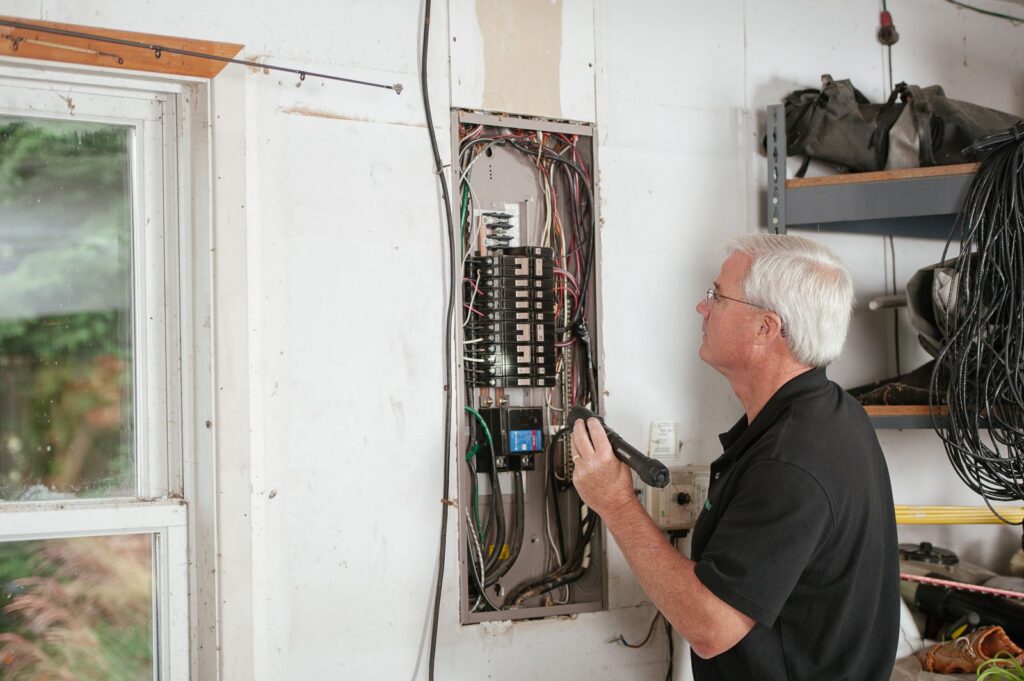
Typical GTA market ranges, not a price list. Every one shifts with access and wiring condition.
- Outlet replacement: around $120–$250
- Pot lights: published figures range from about $100–$150 per light up to $150–$300 per light, and the spread is genuine — retrofitting into a finished plaster ceiling is a different job from an open ceiling with attic access above. A six-light room commonly lands somewhere around $700–$1,800.
- Light fixtures: roughly $70–$250 for a standard ceiling fixture, $100–$300 for a pendant, more for a large chandelier where lifting and access are the real work
- EV charger (Level 2): commonly $1,500–$3,000 all-in where the panel has capacity — see our EV charger page
- Panel upgrade (100A to 200A): roughly $4,000–$6,000 overhead, $5,000–$7,500 underground — fully broken down in our panel upgrade cost guide
- Knob-and-tube replacement: for a typical 1,500–2,500 sq ft Toronto detached, 2026 GTA sources land around $12,000–$25,000; smaller semis start nearer $8,000–$15,000 and large pre-1930 homes run past $30,000. Partial or targeted rewires are $3,500–$12,000. That total is several jobs at once — service upgrade, branch circuits, devices, arc-fault breakers — and it typically excludes plaster patching and paint, which can add thousands. In pre-1930 homes, asbestos or vermiculite abatement is the escalator nobody budgets for.
- Aluminum wiring remediation: priced per device for copper pigtailing, so it scales with how many outlets, switches and fixtures the home has
The five things that actually move the price
- Access. Open walls versus finished walls is the biggest multiplier in residential electrical. Fishing wire through a finished, insulated, plaster-walled century home takes an order of magnitude longer than the same run in a gutted space. In Toronto’s solid-masonry housing — roughly late 1800s to the 1930s — the plaster often sits directly on the brick with no stud cavity to fish through at all, which changes the job entirely. It’s also why an honest quote for work in finished walls carries more contingency than one for open walls: nobody can see what’s back there until it’s open.
- Age and condition of what’s there. A modern panel is straightforward. A 1950s panel with brittle insulation, no bonding and three generations of amateur additions is not.
- Permits and inspections. Required, real, and now you know what they actually cost.
- Materials. Raw copper is up roughly 40% year over year as of mid-2026, though finished Canadian wire and cable is up closer to 10% — so the effect on your bill is real but far smaller than copper headlines imply.
- What gets found. On older homes, opening a wall or panel sometimes reveals something that must be corrected. The right way to handle that is to show you, explain it, and price it before proceeding.
Fixed quote or hourly?
For defined work — a panel upgrade, twelve pot lights, an EV charger — get a fixed quote. You know the number, and overrun risk sits with the contractor, which is where it belongs.
For “something’s wrong and I don’t know what,” hourly with a clear diagnostic fee is more honest. Nobody can fixed-price a fault they haven’t found, and anyone who tries is either padding heavily or about to revise the number.
Reading a quote properly
- Is the ESA notification included, and what’s the split between the ~$92 fee and administration?
- Is the utility isolation included if the job needs power cut at the meter? In Toronto that’s $120 at the meter or $300 at the pole during regular hours — not the $678 figure that circulates online.
- What happens if something unexpected turns up?
- What’s your ECRA/ESA licence number? In Ontario it’s illegal to hire an unlicensed person for electrical work, and it can compromise your insurance. Licensed contractors give the number without hesitating — ours is #7014949.
A dramatically low quote is rarely a better deal. It’s usually the same job with items left out, and they reappear later as extras.
Where we stand
We’re not the cheapest electrician in Toronto and don’t try to be. What we do is tell you what something costs before we do it, show up when we said we would, explain the problem in plain language, and leave your home cleaner than we found it — which sounds minor until you’ve had a trade leave dust through your house.
If you want a real number for real work, tell us what you need. That includes telling you when a job isn’t urgent enough to justify what you’re about to spend.
About these figures: contractor ranges reflect typical GTA market pricing in 2026 together with our own quoting experience — not a price list, not a quote. ESA fees are from ESA’s 2026 residential fee schedule effective April 1, 2026; Toronto Hydro charges from their published Standard Service Charges as of August 2026; copper figures from Statistics Canada’s producer price indexes and the IMF copper price series. Confirm current fees at the time of your project.
Frequently asked questions
What is the hourly rate for an electrician in Toronto?
Published Canadian cost data puts licensed electricians at roughly $80 to $150 an hour in 2026, with Toronto sitting toward the upper half — commonly $95 to $150. It varies by licence level: apprentices around $60 to $80, journeypersons around $80 to $130, and master electricians around $100 to $160. Many contractors quote by the job rather than the hour for defined work, which is usually better for you because the risk of the job running long sits with them.
Why is there a minimum charge for a small job?
Because getting to you costs the same whether the work takes ten minutes or two hours: drive time across the city, a stocked van, insurance, licensing and a trained electrician’s wage. Published data puts a Toronto service call minimum at roughly $150 to $250 including the first hour, or a trip fee of about $75 to $150 plus labour. It’s why bundling several small items into one visit is far better value than three separate calls.
What does an ESA permit really cost?
Much less than most quotes suggest. ESA’s 2026 residential fee schedule sets a $92 minimum notification fee, with a service or panel change filed by a licensed contractor at $86 and an EV charger notification at $86 plus $30. Additions and alterations without service work start at $46. If a quote shows $400 for ‘the ESA permit,’ the regulator’s share is about $92 and the rest is the contractor’s administration — which can be a fair charge, but should be described honestly.
How much more does an emergency call cost?
After-hours, weekend and holiday work typically carries a premium — commonly cited at around one and a half to two times standard rates, though this varies by contractor and is worth confirming directly. The premium is real because someone is being paid to be available overnight. If the problem isn’t genuinely urgent, booking standard hours costs meaningfully less, and a good contractor will tell you when that’s the better call.
Should I get a fixed quote or pay hourly?
For defined work — a panel upgrade, a set number of pot lights, an EV charger — get a fixed quote so the risk of overrun sits with the contractor. For diagnostic work, where nobody yet knows what’s wrong, hourly with a clear diagnostic fee is more honest than an invented fixed price. The right pattern is diagnose, explain, quote the repair, then do it.