
Home » Level 1 vs Level 2 EV Charging
Level 1 vs Level 2 EV Charging
Home » Level 1 vs Level 2 EV Charging
Level 1 vs Level 2 EV Charging
Compare
Level 1 is genuinely enough for some households. Here is how to work out whether yours is one of them before spending on a circuit.
Most EV charging advice assumes you need Level 2. For a meaningful minority of households that is simply not true, and the honest way to decide is arithmetic: how many kilometres do you actually drive on a typical day, and how many hours is the car parked at home?
| Level 1 | Level 2 | |
|---|---|---|
| Supply | Standard 120-volt outlet | 240-volt dedicated circuit |
| Range added per hour | Roughly 6–8 km | Roughly 30–50 km, depending on the charger and the car |
| Typical overnight (12 h) | Roughly 70–95 km | Full charge for most batteries |
| Electrical work needed | A properly dedicated outlet, if you do not already have one | A dedicated circuit, commonly 40 A for a 32 A charger |
| Suits | Plug-in hybrids, and households driving well under 50 km a day | Battery electric vehicles, longer commutes, or two EVs sharing a charger |
| ESA notification | Only if new wiring is installed | Yes — EV chargers have their own notification category |
| Panel capacity | Rarely an issue | Decided by a calculated load, not by empty breaker spaces |
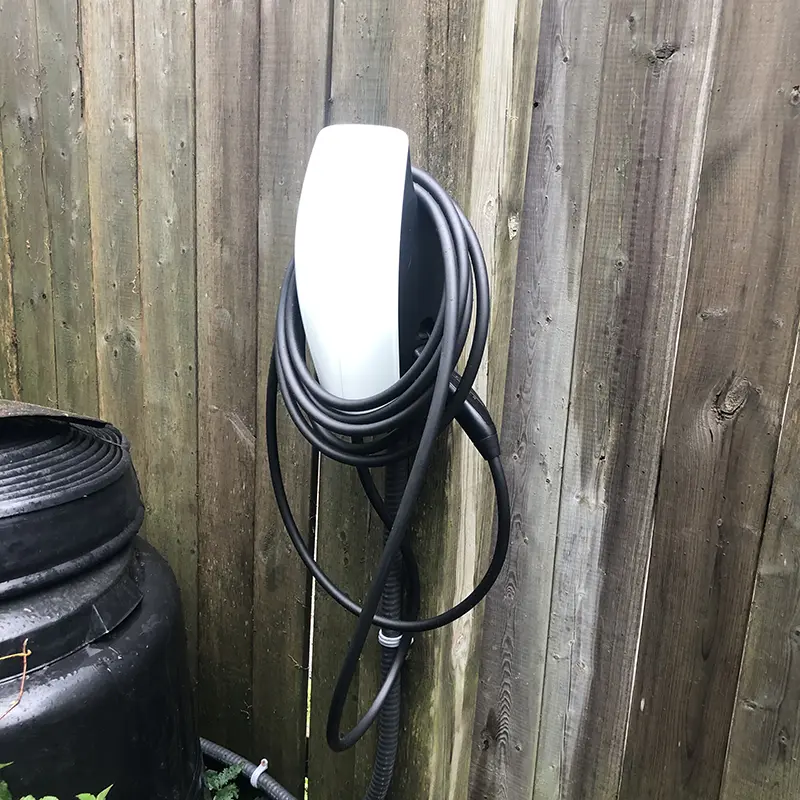
Take your typical daily driving and compare it with what Level 1 delivers overnight. A car parked from 7 pm to 7 am on a 120-volt outlet picks up somewhere around 70 to 95 kilometres. If you drive 40 km a day, Level 1 keeps up comfortably and you have spent nothing.
Where Level 1 stops working is when daily driving approaches what it can replace, because there is no margin left for a longer day. If you regularly drive 80 km or more, or you occasionally arrive home nearly empty and leave early, Level 2 stops being a convenience and becomes the thing that makes the car work.
A dedicated 240-volt circuit sized for the charger — commonly a 40-amp circuit for a 32-amp unit. Whether your service can supply it is settled by a calculated load under the Code, not by how many spaces look free in the panel.
If the calculation comes up short, a load management device usually costs far less than a service upgrade: it sheds the charger when the house draws heavily, so the service is never exceeded. The other cost driver is distance — a charger on a garage wall near the panel is the cheap case; a detached garage across a yard means a buried feed and often a sub-panel.
48-amp chargers are sold hard, and many vehicles cannot accept 48 amps. Where the car tops out at 32, a 48-amp unit costs more in charger, conductor and breaker for no additional range. Check the vehicle’s onboard charger rating before choosing — it is the ceiling, regardless of what the wall unit can deliver.
One thing genuinely worth paying attention to is cable length. Measure from the mounting point to your car’s charge port, which is not in the same place on every model, and add slack. Too short cannot be fixed later.
For some households, yes. Level 1 adds roughly 6–8 km of range per hour, so an overnight charge delivers around 70–95 km. If you drive well under 50 km on a typical day, or you have a plug-in hybrid, it keeps up with no electrical work and no cost. It stops working when daily driving approaches what it can replace, leaving no margin.
Roughly five times. Level 2 adds around 30–50 km of range per hour depending on the charger and the vehicle, against 6–8 km for Level 1. In practice that is the difference between topping up a commute and fully recharging a depleted battery overnight.
Not necessarily. Many 100-amp services take a 32-amp Level 2 charger, particularly where heating, cooking and hot water are gas. It is decided by a calculated load. Where the result is tight, a load management device lets the charger run without ever exceeding the service.
Only if your vehicle can actually accept 48 amps and your service can supply it — many cars cannot, and the extra capacity then buys nothing. A 32-amp charger on a 40-amp circuit suits the overwhelming majority of households.
Yes. EV chargers have their own notification category with the Electrical Safety Authority. A licensed contractor files it under their licence and arranges the inspection. This is an ordinary part of the job, not an optional extra.
If you are in a condo, the constraints are completely different.
Read more →What it costs if the calculation says your service needs to grow.
Read more →Calculated load, dedicated circuit, load management and the rest.
Read more →Related services: EV Charger Installation · Panel & Service Upgrades · 100A vs 200A Service.
Tell us what the house has and what you are planning. We will give you a straight answer.