Key takeaways
- Whether your panel can take a charger is settled by a calculated load under the Canadian Electrical Code, not by how many breaker spaces look free.
- A typical Level 2 install runs on a dedicated 240 V circuit — commonly a 40-amp circuit for a 32-amp charger, or 60 amps for a 48-amp unit.
- There is no EV charger rebate in Ontario in 2026. The Home Renovation Savings Program does not cover chargers or panel upgrades, and the federal charger programs are closed.
- If the load calculation comes up short, an electrical load management device is often far cheaper than a service upgrade — it sheds the charger when the house draws heavily.
- The ESA notification for an EV charger is $86 plus $30. Any quote showing a “permit” in the hundreds is mostly the contractor’s administration.
Most of the EV charging advice written for Toronto is about condos — board approvals, shared
infrastructure, who pays for what in a parking garage. If you own a detached or semi-detached house, almost
none of that applies to you. Your problem is simpler and more technical: can your existing electrical service
actually carry a Level 2 charger, and if not, what is the cheapest honest way to get there?
The short version: a Level 2 charger needs a dedicated 240-volt circuit, and whether your
panel can supply one is decided by a load calculation — not by counting empty breaker spaces. Plenty of
homes with a “full” panel can take a charger, and some homes with spare spaces cannot. And as of
2026 there is no charger rebate in Ontario, so the economics are what they are.
Level 1 or Level 2: what a detached home actually needs
Level 1 is a standard 120-volt outlet. It adds roughly 6 to 8 kilometres of range per hour, which over a
twelve-hour overnight charge is something like 70 to 95 kilometres. For a plug-in hybrid, or for a household
driving well under 50 km a day, that is genuinely sufficient and costs nothing to set up beyond a properly
dedicated outlet.
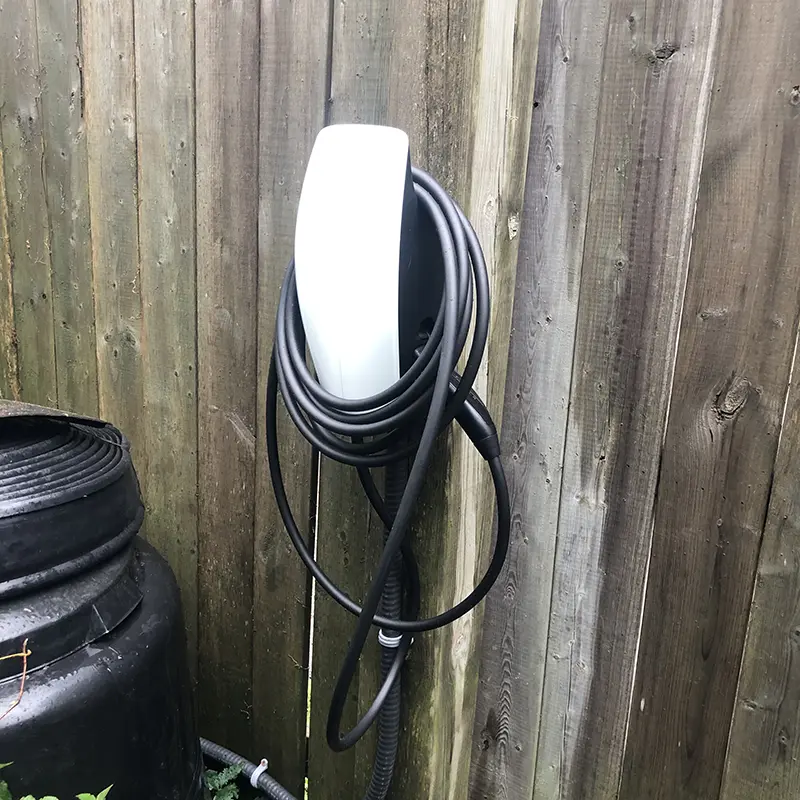
Level 2 is 240 volts on a dedicated circuit, and it is what most detached-home owners end up wanting. A
32-amp charger delivers roughly 7.7 kW and will take a typical battery electric vehicle from low to full
overnight comfortably. A 48-amp unit delivers roughly 11.5 kW, which matters if you have two EVs sharing one
charger or you regularly arrive home nearly empty and leave early.
For the overwhelming majority of houses, a 32-amp charger on a 40-amp circuit is the right answer.
Going to 48 amps requires a 60-amp circuit and considerably more available capacity, and the practical
benefit is small unless the vehicle can actually accept it — many cannot.
Will your panel take it? The load calculation, explained
This is the question that decides the cost of the whole project, and it is the one most commonly answered
wrongly — by homeowners counting empty breaker slots, and occasionally by installers who should know
better.
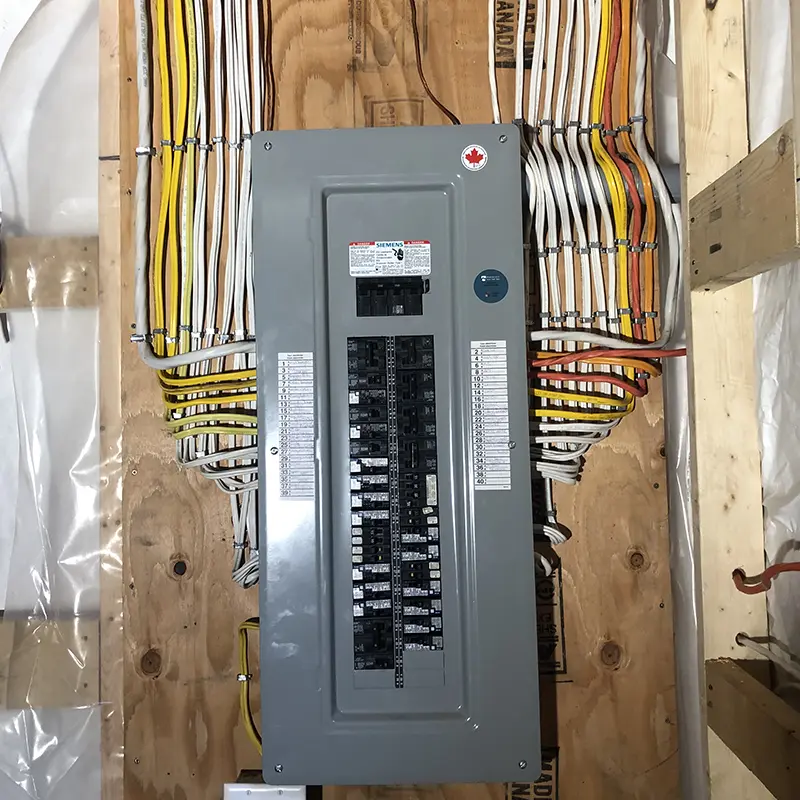
An empty space in the panel means there is somewhere to land a breaker. It says nothing about whether the
service can carry the load. What governs is a calculated load under the Canadian Electrical Code,
which adds up the house’s demand: floor area, electric range, electric dryer, electric water heating, air
conditioning, any electric heat, and now the charger — each with its own demand factor.
The outcomes generally fall into three groups:
- Comfortable headroom. A 200-amp service in a gas-heated house with a gas range and gas
water heating usually has ample room. This is the straightforward case and most of the west GTA’s newer
housing stock sits here. - Tight but workable. A 100-amp service in a gas-heated home can often still take a
32-amp charger, sometimes at a reduced set current. This is very common in Toronto’s older neighbourhoods
and it is where a careful calculation earns its money. - Genuinely short. A 60-amp or 100-amp service in a house with electric heat, an electric
range and electric water heating will not support a Level 2 charger without intervention.
The important point: a calculation that comes up short does not automatically mean a service upgrade.
There is a middle option, and it is usually much cheaper.
Load management: the option that saves most people a service upgrade
An electrical load management device monitors the total current the house is drawing and reduces or
interrupts the charger when the rest of the home is working hard. The Code permits a charger to be installed
on a service that could not otherwise carry it, provided that control is in place, because the charger can
never push the service past its rating.
In practice this is almost invisible to the homeowner. The moments when the house draws heavily —
oven and dryer and air conditioning together on a July evening — are short, and the charger simply
slows or pauses for that period and resumes afterwards. A car parked from 7 pm to 7 am has a great deal more
charging window than it needs.
The cost comparison is stark. A load management device and its installation is generally a small fraction
of a service upgrade, which runs roughly $4,000–$6,000 on an overhead service and
$5,000–$7,500 underground. If your calculation comes up a little short and nobody has mentioned load
management to you, ask why.
There are situations where the upgrade is still the right call: if the service is 60 amps, if the panel
is a fuse box or a format you cannot buy modern breakers for, if you are renovating and adding circuits
anyway, or if you are planning a heat pump as well — which we covered in our
heat pump and panel capacity
guide. Doing the service once, for everything, beats doing it twice.
What the installation involves
The physical work is usually a day or less. The variables are distance and route.
A dedicated circuit runs from the panel to the charger location, sized for the unit — commonly
8 AWG copper on a 40-amp circuit for a 32-amp charger. The charger is either hardwired or fed from a
dedicated receptacle, depending on the unit and where it is mounted. Outdoor installations need equipment
and enclosures rated for the location, and the mounting height and cable management matter more than people
expect when you are handling a cold, stiff cable in February.
Cost drivers, in order:
- Distance from the panel. A charger on the garage wall directly above the panel is the
cheap case. One at the far end of a detached garage across a yard is a different project — that is a
buried feed, a trench, and often a sub-panel. - Route. Surface-mounted conduit in an unfinished basement is quick. Fishing through
finished walls and ceilings is not. - Detached garage. Frequently the single largest variable, because it can turn a
one-circuit job into a small service extension. - Panel work. Whether a breaker lands in an existing panel, or the panel needs a sub-panel
or replacement first.
What we typically quote for a Level 2 installation on a home where the panel has capacity and the charger
sits reasonably close to it: roughly $1,900–$3,600 all-in, including the dedicated
circuit, mounting, commissioning and the ESA notification. Long runs, buried feeds to detached garages and
panel work are quoted on top.
The 2026 rebate picture, honestly
This section is shorter than homeowners hope.
There is no EV charger rebate in Ontario in 2026. Ontario’s Home Renovation Savings
Program pays for a range of home energy retrofits, but chargers and electrical panel upgrades are not among
them. The federal programs that once subsidised home charger installation are closed to new residential
applicants.
What does exist is a vehicle incentive rather than a charging one: Ontario’s EV Availability Program
introduced a rebate of up to $5,000 toward the purchase of an eligible electric vehicle from February 2026.
That helps with the car. It does nothing for the circuit in your garage.
Program terms change, and they change without much notice — so check the current terms on the
official program pages before you rely on any figure, including ours. Any contractor telling you today that
they will “handle the charger rebate paperwork” is describing something that does not currently
exist.
ESA notification and why it is not optional
An EV charger installation requires notification to the Electrical Safety Authority. The published
residential fee is $86 plus $30 for an EV charger.
That is the regulator’s charge. When a quote shows “ESA permit — $400”, roughly $116 of
that is the ESA and the rest is the contractor’s administration for filing and meeting the inspector. That
can be a perfectly legitimate line, but you are entitled to see it described accurately.
Two reasons this matters more for chargers than for most work. First, a charger is a continuous load
drawing near its rated current for hours at a time — it is precisely the kind of circuit where an
undersized conductor or a loose termination will eventually find you. Second, unpermitted electrical work
tends to surface during a home sale or an insurance claim, and a charger is a visible, obvious addition that
an inspector will ask about.
In Ontario this is an ESA notification, not a municipal building permit. A licensed contractor files it
under their own licence number — ours is ECRA/ESA 7014949 — and arranges the inspection.
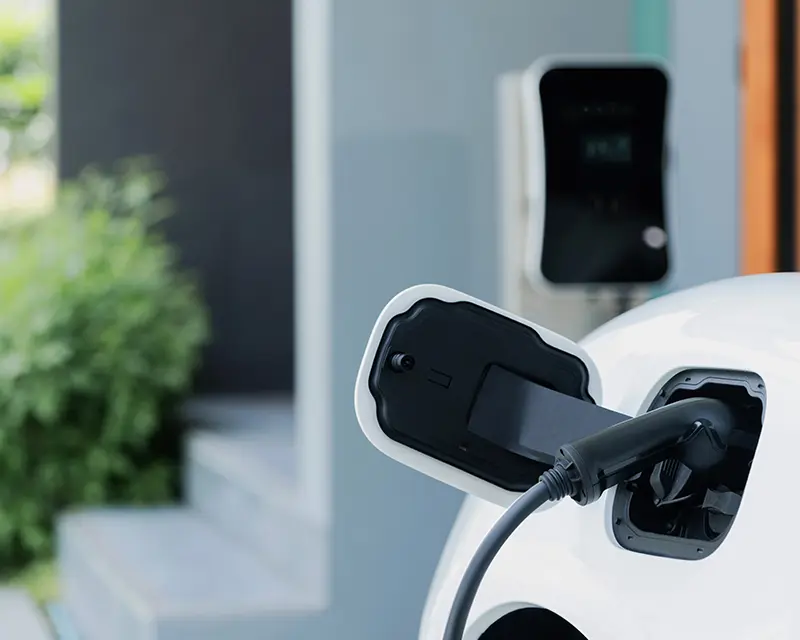
Choosing a charger
Most current Level 2 units are broadly similar in what they deliver. The decisions that actually matter
over five years:
- Cable length. Measure from the intended mounting point to your vehicle’s charge port
— which is not in the same place on every car — and add slack. Too short is the most common
regret, and it cannot be fixed later. - Hardwired or plug-in. Hardwired is tidier and required for some installations. Plug-in
makes replacement and relocation easier. - Amperage. Match it to what the car can accept and what the service can supply. Buying a
48-amp charger for a vehicle that accepts 32 amps just increases the circuit cost. - Outdoor rating, if it is going outside. This is not the place to economise.
- Load management support, if your calculation is tight — some units integrate it.
We install chargers across Toronto, Etobicoke, Vaughan, Oakville, Mississauga, York and East York, mostly
on detached homes where the question is capacity rather than committee approval. Our
EV charger installation page covers our
process, and if you live in a condo the constraints really are different — we wrote about those in our
condo EV charging guide. To get the
load calculation done properly, get in touch.
Frequently asked questions
Deciding between a permanently connected charger and one that plugs in? See hardwired vs plug-in EV chargers.
Can I install an EV charger on a 100-amp service?
Often, yes. A 100-amp service in a gas-heated home with a gas range and gas water heating will frequently support a 32-amp Level 2 charger, sometimes at a reduced set current. It is decided by a calculated load under the Canadian Electrical Code, not by counting empty breaker spaces. Where the calculation is short, a load management device is usually far cheaper than a service upgrade.
How much does a Level 2 EV charger installation cost in Toronto?
Where the panel has capacity and the charger is reasonably close to it, we typically quote roughly $1,900–$3,600 all-in, including the dedicated circuit, mounting, commissioning and the ESA notification. Long cable routes, buried feeds to a detached garage, and any panel or service work are quoted separately.
Is there a rebate for home EV chargers in Ontario in 2026?
No. Ontario’s Home Renovation Savings Program does not cover EV chargers or electrical panel upgrades, and the federal residential charger programs are closed. Ontario’s EV Availability Program offers up to $5,000 toward an eligible vehicle from February 2026, but that is a vehicle incentive, not a charging one. Check current program terms before relying on any figure.
Do I need a permit to install an EV charger in Ontario?
You need an ESA notification rather than a municipal permit. The published residential fee is $86 plus $30 for an EV charger. A licensed contractor files it under their licence and arranges the inspection. If a quote lists a permit costing several hundred dollars, most of that is the contractor’s administration.
What is an electrical load management device?
It monitors the total current the home is drawing and reduces or pauses the charger when the rest of the house is working hard, so the charger can never push the service past its rating. The Code permits a charger on a service that could not otherwise carry it when that control is in place. In practice the charger slows for short peaks and resumes — usually unnoticed overnight.
Do I need a 200-amp service for an EV charger?
Not necessarily. Many 100-amp services take a Level 2 charger comfortably, particularly where heating, cooking and hot water are gas. A service upgrade becomes the right answer when the service is 60 amps, when the panel format is obsolete, when you are adding other large loads such as a heat pump, or when you are renovating and adding circuits anyway.
ESA fees are the Electrical Safety Authority’s published residential rates effective April 1, 2026. Rebate positions reflect the Ontario Home Renovation Savings Program and EV Availability Program as at September 2026; program terms change, so confirm on the official program pages. Cost ranges reflect typical GTA market pricing together with our own quoting experience and are not a quotation. Circuit sizing depends on the specific charger and installation — the manufacturer’s instructions and the Canadian Electrical Code govern.