Key takeaways
- We typically quote $13,000–$19,000 for an automatic standby system on essential circuits and $19,000–$30,000 for whole-home backup, complete, before HST.
- A portable generator inlet with a transfer switch or interlock typically costs $1,400–$3,200 — the cheapest safe way to back up a house.
- Location drives cost: distance to the panel and gas meter and manufacturer clearances matter more than the brand.
- Size from what you need to run, including motor starting loads — not from the size of the house.
- Never backfeed a house through a receptacle, and never run a portable generator indoors or in an attached garage.
A standby generator is one of the few electrical projects where the price range genuinely spans an order of magnitude. A properly installed inlet for a portable generator and a whole-home automatic standby unit both answer the same question — what happens to my house when the power goes out? — but one is a weekend’s worth of work and the other is a small construction project involving an electrician, a gas technician, a concrete pad and, sometimes, the gas utility.
This guide sets out the three ways Toronto homeowners back up a house, what we typically quote for each in 2026, and the specific things that push a project to the top or bottom of its range. It is written for detached and semi-detached homes; condo owners generally cannot install a generator and should talk to their building.
The short version: a properly connected portable generator setup typically runs $1,400 to $3,200 before the generator itself. An automatic standby system covering essential circuits typically runs $13,000 to $19,000 complete, and a whole-home automatic system $19,000 to $30,000 complete. All figures are before HST. The two things that move the number most are where the unit can sit relative to your panel and gas meter, and how much of the house you want it to carry.
The three ways to back up a Toronto house
1. A portable generator with a proper inlet. You own a portable generator, keep it in the garage or shed, and when the power goes out you wheel it outside, plug a single cord into an exterior inlet, and switch selected circuits over using a transfer switch or a panel interlock. Nothing happens automatically — someone has to be home, and able to start and refuel it — but it is by far the least expensive way to keep a sump pump, furnace fan, fridge and some lights running.
2. An automatic standby system for essential circuits. A permanently installed generator, usually natural gas, on a pad outside the house. An automatic transfer switch watches the utility supply; when it fails, the generator starts and the essential circuits — moved onto a dedicated sub-panel — switch over within seconds. When the grid returns, it switches back and the generator shuts down. No one needs to be home.
3. A whole-home automatic standby system. The same idea, but the transfer switch sits at the service entrance and the generator is sized to carry the whole house, usually with load management that sheds a few large loads such as air conditioning or an EV charger when the generator is working hard. From inside the house, an outage becomes a few seconds of darkness.
Which one is right depends less on the house than on the household. A family that travels in winter, someone working from home whose income depends on the network staying up, a basement that floods without its sump pump, or anyone relying on powered medical equipment are all strong cases for an automatic system. If the goal is simply not losing a freezer of food during a two-day ice storm, a portable setup does the job for a fraction of the cost.
What we typically quote in 2026
These are the ranges we typically quote for complete projects in Toronto and the west GTA. They assume a detached or semi-detached house with a reasonable path from the panel and gas meter to the generator location. They are before HST, and each quote we write is itemised so you can see exactly what is and is not included.
| Setup | What it covers | Typical project total |
|---|---|---|
| Portable generator inlet + transfer switch or interlock | Exterior inlet, cord, manual transfer of selected circuits. Generator not included. | $1,400–$3,200 |
| Essential-circuit automatic standby (about 10–14 kW) | Generator, pad, automatic transfer switch, essential-circuit sub-panel, gas connection, start-up | $13,000–$19,000 |
| Whole-home automatic standby (about 20–26 kW) | Generator, pad, service-rated automatic transfer switch, load management, gas connection, start-up | $19,000–$30,000 |
The standby figures include the generator itself, which is the single largest line on the quote, and the natural gas connection made by a licensed gas technician. They do not include a gas meter upgrade if the gas utility decides one is needed, an electrical service upgrade if your existing service cannot support the arrangement, or unusual civil work such as long trenches or retaining walls.
Two more costs belong in any honest comparison. The ESA notification for the electrical work is filed under our licence and is included in our quotes; the ESA’s own minimum notification fee is $92, and the rest of what some quotes call a “permit” is the contractor’s time. And a standby generator needs annual maintenance — oil, filters, battery and a load test — which you should budget for every year of its life.
What moves a generator quote up or down
When two quotes for the “same” generator differ by several thousand dollars, the difference almost always sits in one of these.
- Distance from the panel and the gas meter. Every metre of cable and gas pipe between the generator, the transfer switch and the meter is labour and material. A generator that can sit beside the meter on the side of the house is the cheapest installation there is. One that has to go behind a garage at the back of a deep lot is not.
- Placement and clearances. Manufacturers specify minimum distances from windows, doors, vents and combustible surfaces, and the gas code adds its own. On a narrow Toronto lot, finding a legal location can take more thought than the electrical work. Sometimes the only compliant spot is the expensive one.
- The type of transfer switch. An essential-circuit switch feeding a small sub-panel is simpler than a service-rated switch that sits between the meter and your main panel. Whole-home systems need the latter.
- Load management. Modules that shed air conditioning, an EV charger or a hot tub while the generator is running let a smaller generator cover a larger house. They add a little cost and often save more by allowing a smaller unit.
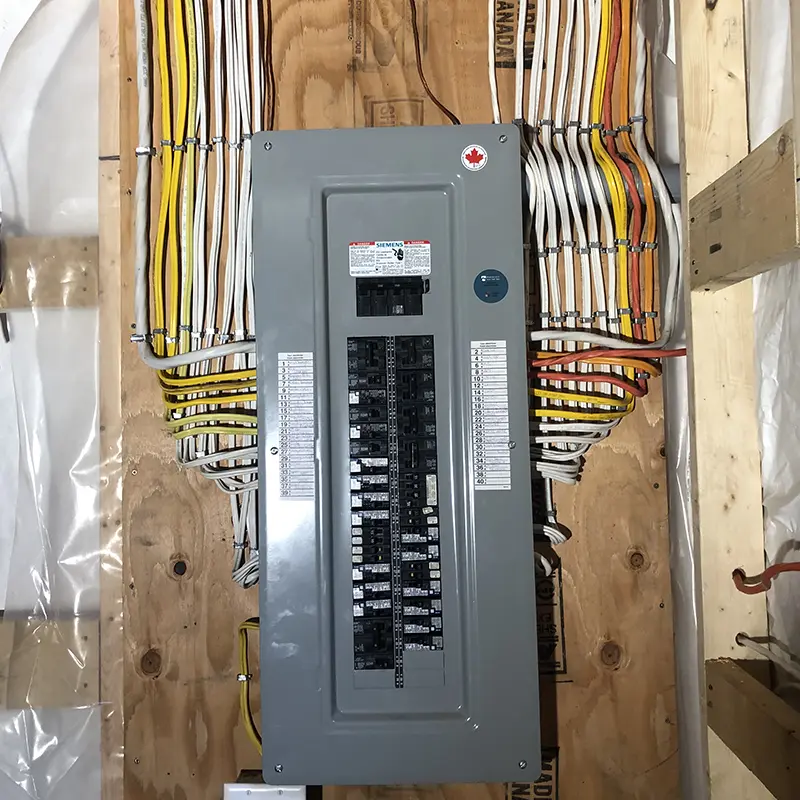
- The state of your panel. A fuse panel or a full breaker panel with no spare spaces usually means a sub-panel or a panel replacement as part of the project. See fuse box vs breaker panel for why.
- Gas supply. A large generator running at the same time as your furnace, water heater and range can exceed what your gas meter was sized for. If so, the gas utility upgrades the meter, on its own schedule.
None of these are visible from a product brochure, which is why a quote given over the phone from a model number is rarely the number you end up paying. A site visit should end with a proposed location, a transfer switch type and a list of the circuits the generator will carry.
How to size a generator properly
Generator sizing is where most of the money is won or lost. Oversize it and you pay for capacity you never use; undersize it and the generator stalls the first time the air conditioning and the well pump start together.
The starting point is a list of what you actually need to run during an outage, not a list of everything in the house. For an essential-circuit system that usually means:
- The furnace (a gas furnace still needs electricity for its blower, controls and igniter)
- The sump pump, and any sewage ejector pump
- Refrigerator and freezer
- A selection of lighting, and the receptacles where phones, laptops and the network equipment live
- Garage door opener, and the well pump on a rural property
Each of those has a running load and, for anything with a motor, a starting surge that can be several times larger for a moment. A competent sizing exercise accounts for both. For a whole-home system, the starting point is the same load calculation used for a service upgrade, which we explain in 100-amp vs 200-amp service, and then load management decides what can be shed while the generator is carrying the house.
A rule of thumb we hear a lot is “get the biggest one you can afford”. It is not a good rule. A generator that runs most outages at a very light load is less efficient, and the extra capacity can cost more than the load management that would have made a smaller unit sufficient.
Toronto-specific things to plan for
Narrow lots. Many Toronto semis and detached houses have a metre or two of side yard. Clearance requirements from windows, doors and the neighbouring house can rule out the obvious spot. Plan the location before you choose the generator, not after.
Neighbours and noise. A standby generator runs a short exercise cycle once a week or once a fortnight, and runs continuously during an outage. Modern units are quieter than they used to be, but on a tight lot it is considerate — and wise — to place the unit away from a neighbour’s bedroom window and to schedule the exercise cycle for midday.
Flood-prone basements. In parts of York near Black Creek, in older East York basements and anywhere with a history of water, the sump pump is often the single most valuable circuit a generator can protect. Storms that cause outages are the same storms that fill basements.
Older services. A 60-amp or older 100-amp service may need work before a whole-home transfer switch can be added. That does not rule out a generator; it often points to an essential-circuit system instead. Our guide to the Toronto Hydro service upgrade process explains the timeline if an upgrade is needed.
Underground is not outage-proof. Homeowners in newer subdivisions or in Oakville with underground distribution sometimes assume they do not need backup. Underground lines resist storm damage on your own street, but feeders and stations upstream still fail — in August 2026 a single upstream failure at Toronto Hydro’s Basin transformer station cut power to roughly 31,000 customers.
Portable generators: the safety rules that matter
If you go the portable route, two rules are non-negotiable.
Never backfeed the house. Plugging a generator into a household receptacle with a double-ended cord — sometimes called a “suicide cord” for good reason — energises your wiring and, through your service, the utility lines outside. A line worker who believes those lines are dead can be killed. It is also illegal. A transfer switch or an approved panel interlock makes it physically impossible for the generator and the grid to be connected at the same time. That is the whole purpose of the inlet installation, and the reason it is notified to the ESA.
Never run it indoors. Portable generators produce carbon monoxide in quantities that kill. Never run one inside the house, in an attached garage — even with the door open — or close to windows, doors or vents. Ontario already requires carbon monoxide alarms in homes with fuel-burning appliances or an attached garage; make sure yours work before winter.

Beyond those two, run the generator on a level surface outside, store fuel safely, and start it every few months so it actually works when you need it. For the vocabulary — inlet, interlock, transfer switch, backfeed — our electrical terms glossary has plain-English definitions.
Is a standby generator worth it?
For most Toronto households, the honest answer is that it depends on what an outage would actually cost you.
The December 2013 ice storm left hundreds of thousands of Toronto Hydro customers without power, some for more than a week over Christmas. Outages of that length are rare, but they are when frozen pipes, flooded basements and spoiled food turn an inconvenience into an insurance claim. Shorter outages of a few hours are far more common and mostly a nuisance — unless you work from home, rely on medical equipment, or have a basement that floods without its pump.
A useful way to decide:
- If the main risk is losing food and comfort in a long outage, a portable generator with a proper inlet is usually enough.
- If the main risk is water in the basement or a household where someone must have power, an automatic essential-circuit system is the sensible minimum.
- If you want an outage to be a non-event and the house is large, a whole-home system with load management is the answer.
Our standby generator installation page explains how we approach these projects, and there are local guides for Toronto, Etobicoke, Vaughan and Oakville, where lots, outage patterns and utilities differ.
How to compare generator quotes
When the quotes arrive, line them up against these questions. A good quote answers all of them without being asked.
- Which generator, and what size? Make, model and rated output in kilowatts on natural gas.
- Which transfer switch? Automatic or manual, essential-circuit or service-rated, and its amperage.
- Which circuits will it carry? A list, not “essential loads”.
- Where will it go? A proposed location that meets the manufacturer’s clearances.
- Who does the gas? The gas connection must be made by a licensed gas technician. Is it included?
- Is the ESA notification included? And the pad, the start-up and the first service?
- What is excluded? Gas meter upgrade, service upgrade, landscaping restoration, HST.
Ontario’s consumer protection rules require renovation contracts to be written and itemised. If two quotes differ widely, set them side by side against this list — the gap is almost always scope, not margin. For broader context on electrical pricing, see how much an electrician costs in Toronto.
Frequently asked questions
How much does a standby generator cost installed in Toronto?
We typically quote $13,000 to $19,000 for a complete automatic standby system covering essential circuits, and $19,000 to $30,000 for a whole-home system with load management, before HST. A portable generator inlet with a transfer switch or interlock typically runs $1,400 to $3,200, not including the generator.
What size generator do I need for my house?
It depends on what you need to run, not the size of the house. An essential-circuit system covering the furnace, sump pump, fridge, lighting and receptacles is often 10 to 14 kW. A whole-home system is commonly 20 to 26 kW with load management. A proper sizing exercise accounts for motor starting loads as well as running loads.
Do I need a permit to install a generator in Ontario?
The electrical work must be notified to the Electrical Safety Authority and inspected; a licensed contractor files it under their own licence. The natural gas connection must be made by a licensed gas technician. Your municipality may have placement rules, so check before choosing a location.
Can I plug a portable generator into a wall outlet?
No. Backfeeding a house through a receptacle can energise utility lines and kill a line worker, and it is illegal. Use a properly installed inlet with a transfer switch or approved interlock, which makes it impossible for the generator and the grid to be connected at once.
Will a generator run my furnace during an outage?
Yes, if the furnace circuit is included. A gas furnace still needs electricity for its blower, controls and igniter, which is why the furnace is one of the first circuits on any essential-circuit list.
How often does a standby generator need maintenance?
At least once a year: oil and filter change, battery check, inspection and a load test. Most units also run a short automatic exercise cycle every week or two, which keeps them ready and lets you spot problems before an outage.
Prices are what Northcliffe Electric typically quotes for complete residential projects in Toronto and the west GTA in 2026, before HST; your quote will be itemised for your house. ESA minimum notification fee from the ESA’s published 2026 residential fee schedule. Outage figures from Toronto Hydro reporting on the December 2013 ice storm and the August 2026 Basin transformer station failure.