The short version: GTA contractors publishing 2026 prices cluster around $4,000–$6,000 for a 100A to 200A upgrade on an overhead service, and $5,000–$7,500 where the service is underground. Two numbers you’ll see quoted everywhere are wrong: the ESA fee is about $92, not $300, and Toronto Hydro’s isolation charge is $120 at the meter, not $678.
Panel upgrade pricing is the most-searched electrical question in Toronto and the worst-answered. National calculators give you American numbers. Local contractors mostly publish nothing. And two specific figures have been repeated so often that they’ve become folklore.
So we went to the primary sources — ESA’s published fee schedule and Toronto Hydro’s published service charges — and here’s what the pricing actually looks like.
The realistic range in 2026
Compiling what GTA contractors publish for a full 100A to 200A service upgrade in 2026, the numbers cluster tightly:
- Overhead service: roughly $4,000–$6,000.
- Underground service: roughly $5,000–$7,500. Underground is consistently the single largest cost swing in this job.
You’ll also find pages advertising panel upgrades from $1,200. Those are almost always describing something different, which brings us to the most important thing to understand before you compare quotes.
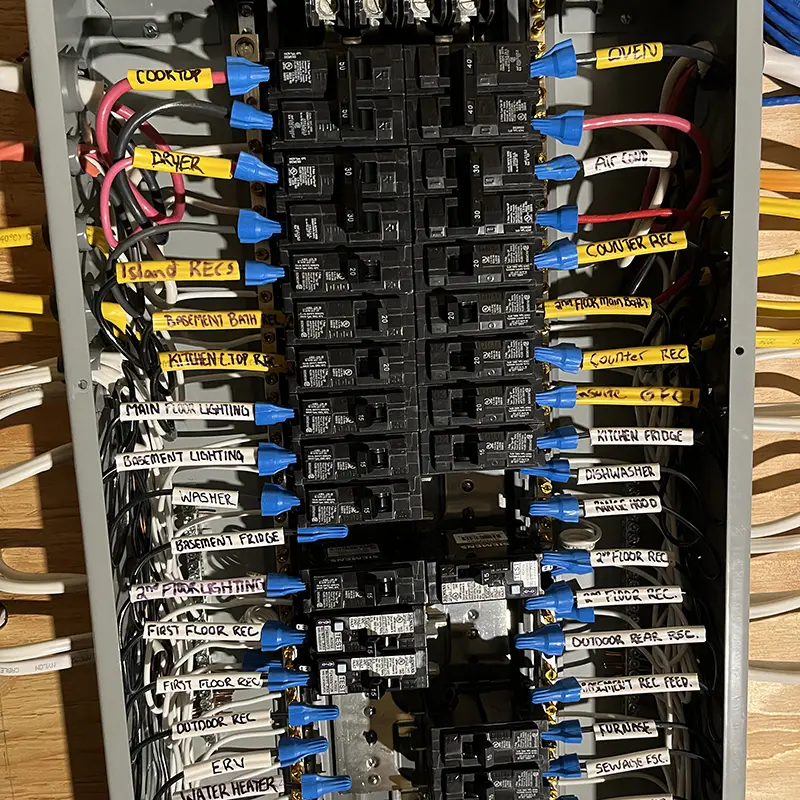
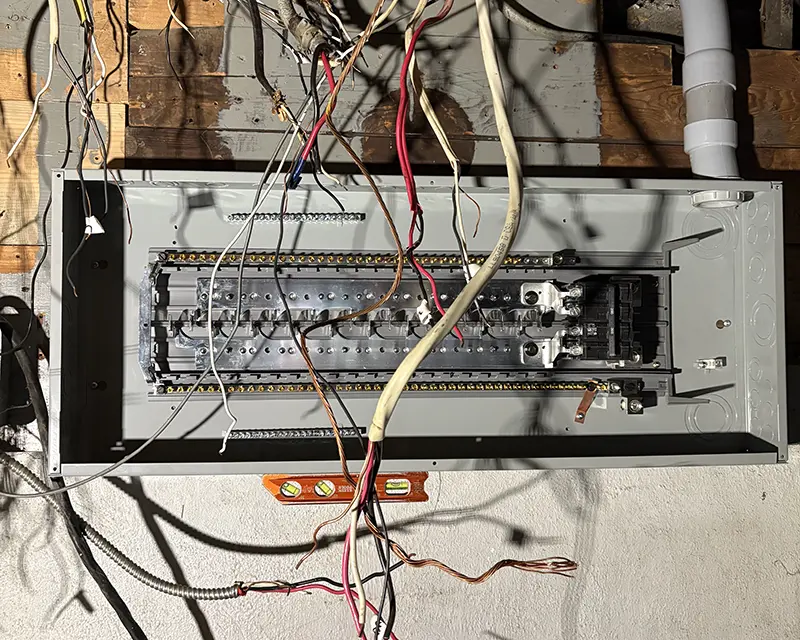 Before
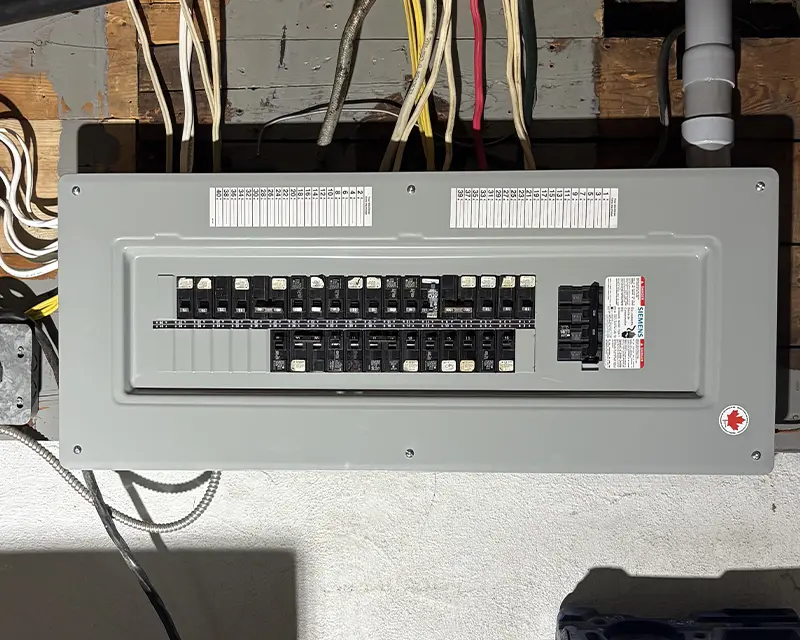 After
After“Panel upgrade” means three different jobs
Most of the confusion in this market is definitional, not regional. Three distinct jobs get sold under one name:
- Like-for-like panel replacement — a new panel, same service size, utility connection untouched. Roughly $1,500–$3,000 for 100A, $2,000–$3,500 for 200A. This is the right job when the panel is tired but the capacity is fine, and it’s the cheapest of the three by a wide margin.
- Full service upgrade — new panel plus new service conductors, mast or underground feed, meter base, and a utility reconnection. The $4,000–$7,500 job above.
- Fuse box to breaker panel — roughly $2,500–$4,500 if the service size stays as it is, but the common Toronto case is a 60-amp fuse panel that needs a full service upgrade at the same time, which lands closer to $4,000–$6,000.
A sub-panel, for a garage or a basement suite, typically runs $1,000–$2,500.
When a quote looks dramatically cheaper than the others, this is almost always why: it’s pricing a different job.
The ESA fee, from the actual fee schedule
This is where homeowners are most often overcharged, and it’s easy to check. From ESA’s 2026 residential fee schedule, effective April 1, 2026:
- Minimum notification fee: $92
- Service change, panel change or new service, filed by a licensed contractor: $86 (which the $92 minimum then applies to)
- EV charger: $86 plus $30
- Additions and alterations with service work: $105 for 1–10 outlets, rising with outlet count
- Pool or hot tub: $168
ESA raised wiring and licensing fees by 1.9% on April 1, 2026, so quotes prepared before then may show slightly lower figures.
If a contractor’s quote lists “ESA permit — $400,” that’s roughly $92 of regulator fee and about $300 of their own administration. That may well be a legitimate charge for handling the filing, scheduling the inspection and being there for it — but it should be described as what it is. Ask.
One more correction worth making: Ontario electrical work is authorized by an ESA notification, not a municipal electrical permit. The City of Toronto does not issue a separate electrical permit for a panel or service change. You may still need a building permit for other parts of a renovation — they’re different things.
The Toronto Hydro fee, and the $678 myth
To work on the meter base or service mast, the power has to be isolated by the utility and then reconnected. That’s a real, separate cost, and many quotes leave it out.
What it actually is, from Toronto Hydro’s published Standard Service Charges:
- Isolation at the meter: $120 during regular hours, $400 after hours
- Isolation at the pole or overhead transformer: $300 during regular hours, $820 after hours
- A residential disconnection requested by the customer is listed as no charge, recovered through rates
- HST applies
The widely-quoted $678 figure is not a Toronto Hydro rate. It appears nowhere in their Conditions of Service or their service charge listing. It traces to a single homeowner’s job quote posted on a forum in late 2023, which a contractor blog republished as a rate and which then spread into cost guides. If you’ve been quoted “$678 for the hydro fee,” ask what specifically it covers.
Two other Toronto Hydro realities that affect price and timing:
- Indoor meters must move outside. Toronto Hydro requires meters for new or upgraded residential services to be mounted outdoors on an approved socket. Older Toronto homes frequently have the meter inside, and relocating it adds scope.
- Lead time is roughly a month to coordinate the isolation. Book earlier than feels necessary.
Outside Toronto the picture differs. In Alectra territory — Mississauga and Vaughan — residential customers get one free isolation and re-energization per year for electrical maintenance or upgrade work during business hours.
What actually pushes a quote up
- Overhead versus underground. The biggest single swing, worth $1,000 or more.
- Service entrance condition. A 200-amp service needs larger conductors than an old mast was built for, so mast and weatherhead replacement is common. Budget roughly $300–$700 for a meter base alone, or $800–$1,600 for mast and meter base together.
- Indoor meter relocation, per the rule above.
- Panel location. A panel in a finished room or a tight crawlspace costs more than one on an open basement wall, and relocating it adds drywall repair on top.
- Code corrections found once the panel is open — missing bonding, undersized grounding, double-tapped breakers.
- Old wiring behind the panel. Knob-and-tube or aluminum branch circuits raise questions the upgrade alone doesn’t answer.
- ESA re-inspection fees if something fails, or a $177 charge if the site isn’t ready when the inspector arrives — a good reason to use a contractor who schedules properly.
Has copper pushed prices up? Yes — but less than the headlines suggest
This is worth getting right, because the copper story is usually overstated. Comparing the second quarter of 2026 against the same period in 2025:
- Raw copper is up roughly 40% year over year, on both the IMF price series and Statistics Canada’s producer price index for unwrought copper.
- Finished electrical wire and cable made in Canada is up roughly 10% over the same period, per Statistics Canada’s producer price index.
The gap between those two numbers is the useful part. Finished wire contains a great deal besides copper — insulation, manufacturing, distribution — so a 40% jump in the metal translates into a much smaller increase at the supply house. The Canadian dollar was essentially flat against the US dollar over the period, so there’s no currency effect on top.
Practically: a panel upgrade quoted today will cost somewhat more than one quoted two years ago, but the increase is measured in a few hundred dollars of material, not thousands.
Do you actually need the upgrade?
Not everyone does. If you’re not adding an EV charger, a heat pump, central air or a large renovation, and your panel is in good condition with free slots, 100-amp service may be genuinely fine.
The honest test is a load calculation — your home’s calculated load against your service rating. And if capacity is the only obstacle, ask about load management: Ontario’s electrical code recognizes energy management systems, and they can sometimes let you add a major load without touching the service. It’s frequently cheaper, and a contractor who never mentions it isn’t giving you the full picture.

Signs your panel is telling you something
- Breakers that trip repeatedly on the same circuit
- A panel warm to the touch, buzzing, or smelling hot
- Fuses, or no free breaker slots left
- Lights dimming noticeably when large appliances start
- Scorching, rust or moisture inside the panel
- An insurer asking questions at renewal
Heat or smell means call now, not at quoting leisure — see our emergency service.
Four questions that sort good quotes from bad
- Which of the three jobs is this? Panel swap, full service upgrade, or fuse-to-breaker with a service change.
- What’s in the ESA line? Roughly $92 is the fee; anything above that is administration, which is fine if it’s described honestly.
- Is the utility isolation included, and at the meter or the pole? $120 versus $300 is a real difference.
- What’s your ECRA/ESA licence number? You can verify it. Ours is #7014949.
Getting a real number for your home
No blog post can price your specific house. What we’ll do is look at the actual panel and service entrance, run the load calculation, tell you honestly whether you need the upgrade at all, and give you an itemized number with the ESA and utility fees shown separately — before any work starts.
That’s the same wherever you are: Toronto, Etobicoke, East York, Mississauga or anywhere else we serve. Get in touch and we’ll book a look.
About these figures: contractor price ranges reflect typical GTA market pricing in 2026 together with our own quoting experience — they are not a price list and not a quote. ESA fees come from ESA’s 2026 residential fee schedule effective April 1, 2026, and utility charges from Toronto Hydro’s published Standard Service Charges as of August 2026. Fees change — confirm current amounts at the time of your project.
Frequently asked questions
How much does a 100 to 200 amp upgrade cost in Toronto?
Across GTA contractors publishing 2026 pricing, the consensus for a full 100A to 200A service upgrade is roughly $4,000 to $6,000 where the service is overhead, and about $5,000 to $7,500 where it runs underground. Jobs needing a new mast, a meter relocation or significant code corrections sit at the top of those ranges or above. Be careful comparing quotes: some contractors advertise a like-for-like panel swap as a ‘panel upgrade,’ and that is a different, cheaper job.
What does the ESA permit actually cost?
Far less than most people are told. Under ESA’s 2026 residential fee schedule, effective April 1, 2026, a service change or panel change filed by a licensed contractor is $86, subject to a $92 minimum notification fee. An EV charger notification is $86 plus $30. If a contractor is quoting you $300 or $500 for ‘the ESA permit,’ most of that is their administration markup, not the regulator’s fee. Also worth knowing: Ontario electrical work is authorized by ESA notification, not a municipal electrical permit — the City of Toronto doesn’t issue a separate one for a panel change.
Is there really a $678 Toronto Hydro fee?
No — and this one is worth correcting because it’s repeated all over the internet. That figure traces back to a single homeowner’s quote posted on a forum in 2023, which cost guides then republished as if it were a rate. Toronto Hydro’s published Standard Service Charges are $120 to isolate at the meter during regular hours and $300 at the pole or overhead transformer, rising to $400 and $820 respectively after hours, plus HST. A residential disconnection requested by the customer is listed as no charge, recovered through rates.
How long does a panel upgrade take?
The work itself is usually a single day, with the power off for a good part of it. The calendar is the slower part: coordinating the utility isolation typically needs around a month of lead time with Toronto Hydro, so book earlier than you think you need to. Service upgrades involving the utility connection take longer to schedule than a straight panel swap.
Do I actually need 200 amps?
Not everyone does. If you’re not adding an EV charger, a heat pump, air conditioning or a major renovation, a sound 100-amp service may be perfectly adequate. The honest test is a load calculation rather than the number on your main breaker. Where the upgrade genuinely pays is electrification — and if capacity is the only obstacle, ask about load management equipment, which Ontario’s code recognizes and which can sometimes let you add a large load without upgrading the service at all.