
Home » 100-Amp vs 200-Amp Service
100-Amp vs 200-Amp Service
Home » 100-Amp vs 200-Amp Service
100-Amp vs 200-Amp Service
Compare
The honest answer is that plenty of Toronto homes are fine on 100 amps — and the ones that are not have a specific reason.
A 200-amp service is treated as the default recommendation, and for a lot of homes it is simply not necessary. What decides it is the calculated load under the Canadian Electrical Code — what the house actually draws — not its age, its square footage, or how many empty spaces are in the panel.
| 100-amp service | 200-amp service | |
|---|---|---|
| Typical in | Homes built or upgraded roughly 1960–2000, and many smaller semis and row houses today | New construction, larger detached homes, and any home with substantial electric load |
| Comfortably carries | Gas heat, gas range, gas hot water, air conditioning, ordinary lighting and appliances | All of the above plus electric range, electric hot water, EV charging and a heat pump |
| EV charger | Frequently yes — a 32-amp charger often fits, sometimes with load management | Yes, usually with room to spare |
| Heat pump | Often tight; depends heavily on what else is electric | Generally straightforward |
| Electric range + dryer + AC | Possible but close to the limit; needs calculating carefully | Comfortable |
| Utility involvement to upgrade | n/a | Yes — the service is disconnected and reconnected, which the utility schedules |
| Toronto overhead limit | Within limit | At the limit — Toronto Hydro caps overhead residential services at 200 amps |
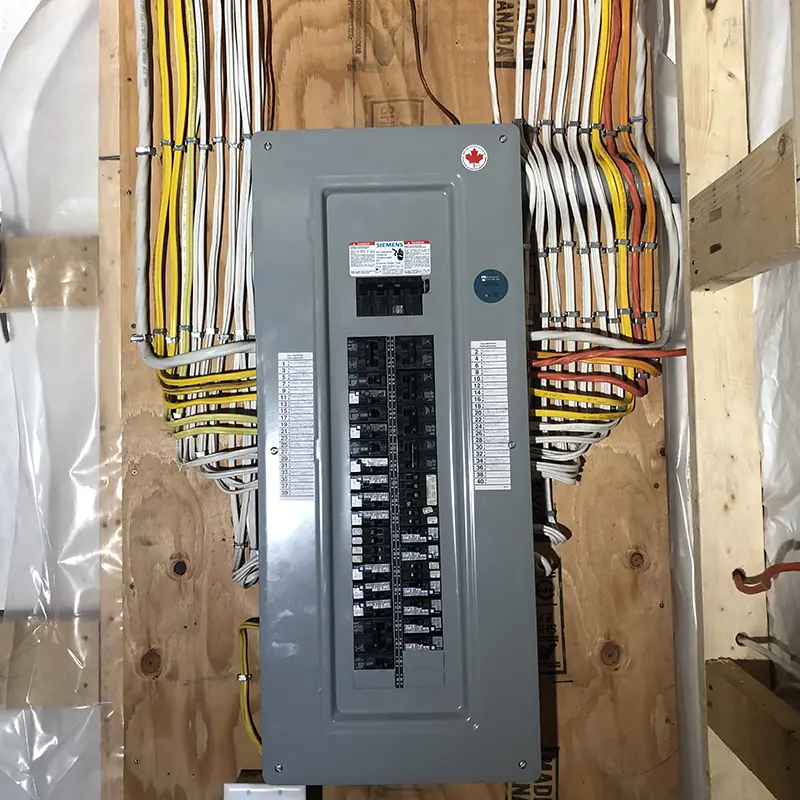
A gas-heated home with a gas range and gas water heating puts a surprisingly modest demand on its service. Add central air and ordinary appliances and a 100-amp supply still has headroom. A great many Toronto semis and row houses are in exactly this position, and upgrading them buys nothing but a smaller bank balance.
The test is the calculation, and it is worth having done before you accept a recommendation to upgrade. An electrician who recommends 200 amps without asking what heats your home and water has not done the arithmetic.
The upgrade earns its place when the calculated load says so, and that usually means one of a few specific things: electric heat, an electric range together with electric hot water, a heat pump, or an EV charger landing on a service that is already close to its limit. Adding a second dwelling unit is another — a second kitchen is a substantial load.
It also earns its place when the existing panel is a format you cannot buy modern breakers for, or a fuse panel, because then capacity is not the only problem.
Where the calculation comes up a little short for an EV charger specifically, an electrical load management device lets the charger be installed on a service that could not otherwise carry it. It sheds the charger when the rest of the house draws heavily, so the service can never be exceeded.
It costs a fraction of a service upgrade. If your calculation is marginal and nobody has mentioned it, ask why.
Very often, yes. A gas-heated home with a gas range and gas water heating typically has comfortable headroom on 100 amps, even with central air. What changes the answer is electric heat, an electric range combined with electric hot water, a heat pump, or an EV charger on an already-loaded service. It is decided by a calculated load, not by the age of the house.
Frequently, yes. Many 100-amp services take a 32-amp Level 2 charger, particularly where heating, cooking and hot water are gas. Where the calculation is tight, a load management device lets the charger run while preventing it from ever pushing the service past its rating — usually far cheaper than an upgrade.
The main breaker in your panel is usually labelled with its rating — 60, 100 or 200. Do not rely on the panel's physical size or the number of spaces, which say nothing about the supply. If the main is a fuse block rather than a breaker, you are likely on an older, smaller service.
No. You are billed for the energy you use, not for the capacity available to you. A 200-amp service sitting mostly idle costs no more to run than a 100-amp one.
In Toronto, not on an overhead service — Toronto Hydro caps overhead residential at 200 amps, so anything larger has to be supplied underground with the customer paying the civil work. Oakville requires underground for all new and replaced services at any size.
What the upgrade actually costs, and the two figures most quotes get wrong.
Read more →The rebate covers the heat pump and none of the electrical work it needs.
Read more →Calculated load, ampacity, service entrance and the rest, in plain English.
Read more →Related services: Panel & Service Upgrades · EV Charger Installation · Fuse Box vs Breaker Panel.
Tell us what the house has and what you are planning. We will give you a straight answer.