Key takeaways
- You own the mast, weatherhead and meter base; the utility owns the wire to it and the meter.
- The utility cannot reconnect until a Licensed Electrical Contractor repairs it and the ESA authorises it.
- We typically quote $1,800–$3,500 for mast and weatherhead work, plus ESA and utility charges.
- Storm damage is normally covered by home insurance subject to your deductible — keep the ESA certificate.
- Damage can exist while you still have power. Check the mast from the ground after any serious storm.
There is a specific kind of power outage that catches homeowners completely off guard. The street has power. Your neighbours have power. You do not. You call the utility, and they tell you the problem is on your side and you need to hire an electrician.
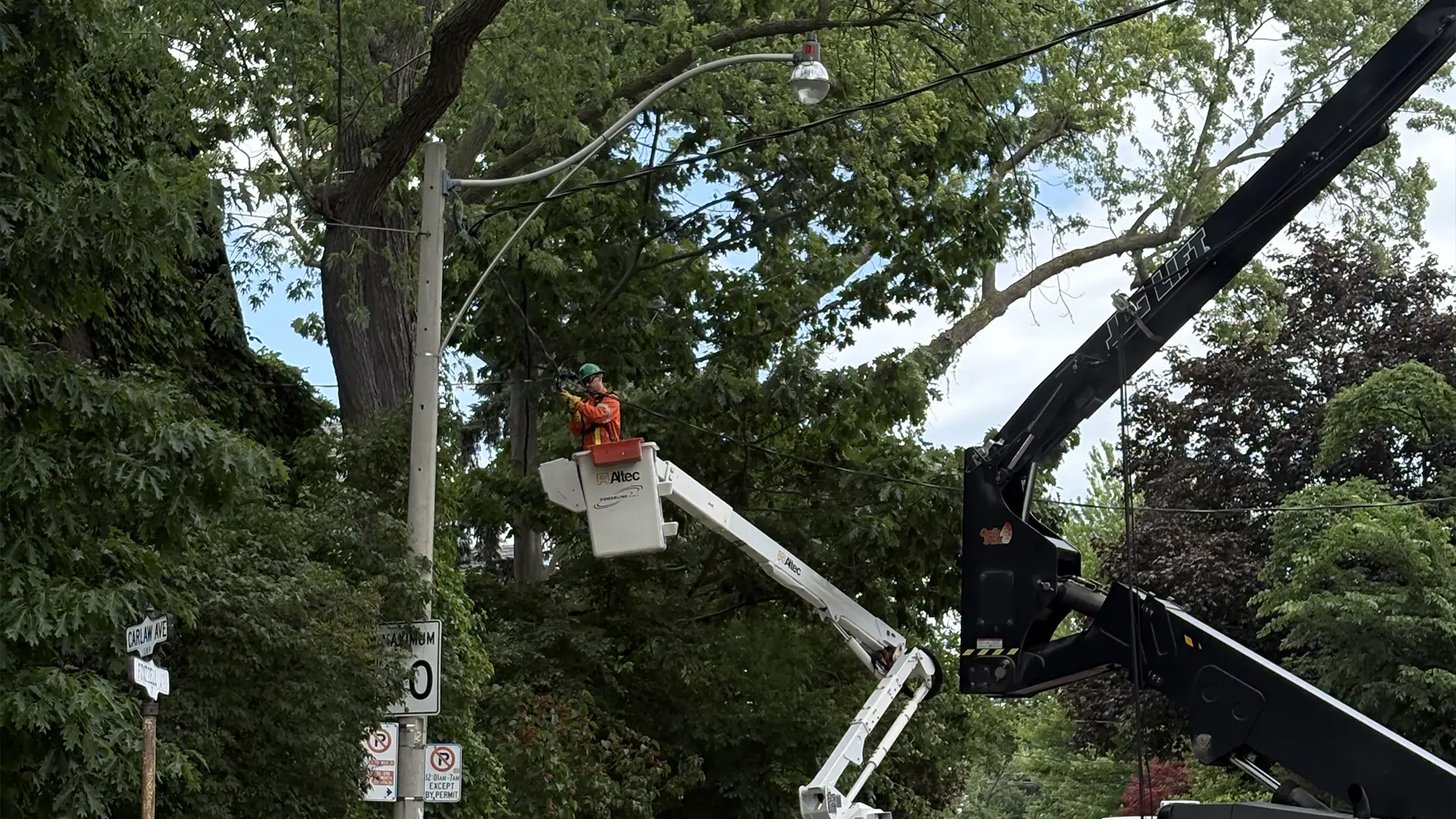
That conversation usually means the same thing: the service mast — the metal pipe carrying the overhead wires down to your meter — has been pulled, bent or torn away from the house. A falling branch does it. So does ice loading, and so does a tree coming down two properties over and dragging the line with it.
The part that surprises people is the ownership. You own the mast, the weatherhead, the attachment hardware and the meter base. The utility owns the wire running to it and the meter itself. They will not repair your equipment, and they are not permitted to reconnect power to a damaged service. Until a Licensed Electrical Contractor repairs it and the Electrical Safety Authority authorises reconnection, your house stays dark.
This guide covers what that repair involves, what it typically costs in Toronto and the west GTA, how long reconnection realistically takes, and what your insurer usually pays for.
The part of the service you own
On an overhead service, the dividing line sits at the top of your mast. Toronto Hydro, Alectra and Oakville Hydro all draw it the same way, and it is worth knowing before you ever need it.
| Component | Who owns it | Who repairs it |
|---|---|---|
| Overhead wire from the pole to your house | The utility | The utility |
| The electricity meter itself | The utility | The utility |
| Weatherhead and attachment hardware | You | Licensed Electrical Contractor |
| Service mast and the conductors inside it | You | Licensed Electrical Contractor |
| Meter base (the box the meter plugs into) | You | Licensed Electrical Contractor |
| Everything from the meter base into your panel | You | Licensed Electrical Contractor |
This is why the utility’s answer is so often “that is not ours.” It genuinely is not. On an underground service the split is similar, with the boundary at the line side of your meter base.
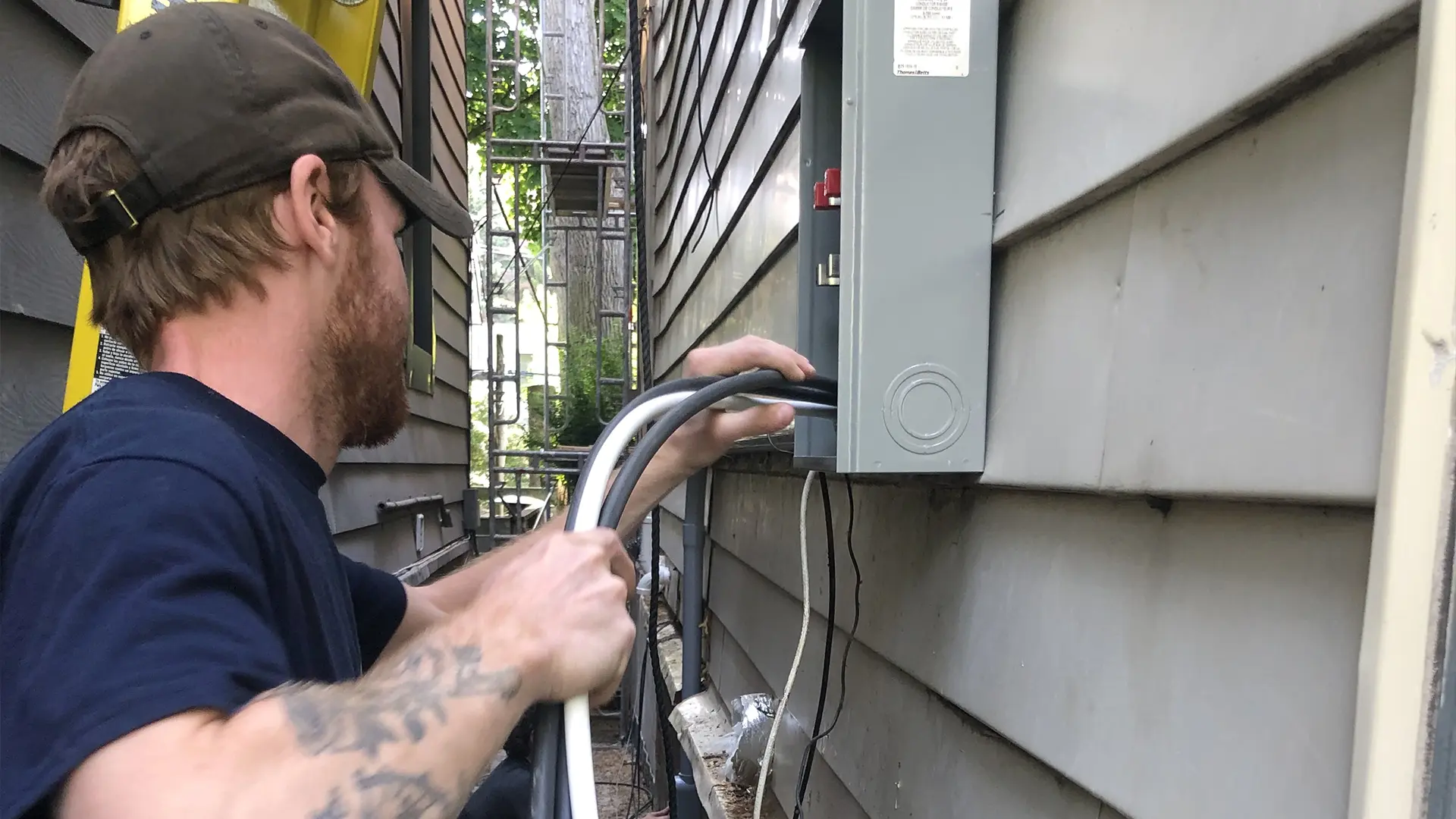
One important consequence: a handyman cannot do this work, and neither can you. In Ontario, work on the service entrance must be done by a Licensed Electrical Contractor. Using anyone else does not just risk the work — it will stop the reconnection, because the ESA will not authorise it.
How to tell it is your problem and not the grid’s
Before you call anyone, two checks tell you most of what you need to know.
- Look at your neighbours. If the street is dark, it is a grid outage and there is nothing an electrician can do for you. Report it to your utility and wait. If their lights are on and yours are not, the fault is almost certainly on your side of the meter.
- Look up at the house, from the ground. Do not climb, do not touch anything, and stay well back from any wire that is down. You are looking for a mast that is leaning, bent at the roofline, pulled away from the wall, or separated from the wires; a weatherhead hanging loose; or a meter base pulled off its mounting or visibly cracked.
There is a third case worth knowing, because it is the one people miss. You can have damage and still have power. A mast that has been pushed out of alignment but has not broken the connection will keep feeding the house while the weather seal is gone and water is running into the conduit. That is a problem that announces itself weeks later, and it is worth a look after any serious storm even if nothing went dark.
If you see arcing, smell burning, or see a wire down anywhere near the property, that is an emergency call to the utility and to 911 if anyone is at risk — not a quote request. Our guide to electrical emergency signs covers what warrants an immediate call.
What has to happen before the power comes back
Reconnection follows a fixed sequence, and knowing it prevents a lot of frustration. Every step has a different party doing it.
- You hire a Licensed Electrical Contractor. They attend, assess the damage, and tell you whether it is a repair or whether the service has to be replaced.
- The contractor files a notification with the ESA. This is the Ontario equivalent of pulling the permit, and the contractor does it, not you.
- The utility disconnects. If the service is still live, or the meter has to come off, the utility has to isolate it before work starts. This is scheduled, and it is the step most likely to add a day.
- The contractor does the work — new mast, weatherhead, conductors, straps, and the meter base if it is damaged.
- The ESA inspects and authorises. The inspector confirms the work is safe and notifies the utility that it can reconnect.
- The utility reconnects. On their schedule, not yours.
You cannot skip or reorder these. In particular, the utility will not reconnect on your contractor’s say-so — it waits for the ESA. That is the single most common cause of “the work is finished, why am I still dark.”
Ask your contractor for the ESA Certificate of Acceptance when the job is done. It is the document that proves the repair was inspected, and it is what your insurer will ask for. It is also what a buyer’s lawyer will want if you sell.
What it costs
A service entrance repair has three separate cost components, and only one of them is the contractor’s labour. Separating them is the fastest way to tell a fair quote from a bad one.
| Component | Typical 2026 cost | Who sets it |
|---|---|---|
| ESA notification | $92 minimum; $86 for a service repair or change | The ESA, published |
| Utility isolation at the meter | $120 regular hours, $400 after hours | Toronto Hydro, published |
| Utility isolation at the pole | $300 regular hours, $820 after hours | Toronto Hydro, published |
| Mast, weatherhead, conductors and labour | Typically $1,800–$3,500 | Your contractor |
| Meter base replacement, if damaged | Typically add $600–$1,200 | Your contractor |
| If it becomes a service upgrade | $4,000–$6,000 overhead, $5,000–$7,500 underground | Your contractor |
Figures are before HST and assume ordinary access. If you are in Alectra territory — Mississauga and Vaughan — residential customers get one free planned disconnection and reconnection per twelve months, which can remove the isolation charge entirely if the work can be scheduled rather than done as an emergency.
Two things commonly turn a repair into a bigger job. The first is a meter base that has been pulled or cracked, because once it is being replaced the whole service entrance is effectively being rebuilt. The second is discovering the existing service is undersized or in poor condition while it is already open — at which point upgrading costs far less than doing it twice. Our panel upgrade cost guide covers that decision, and 100 amp versus 200 amp service covers whether you need the capacity.
A note on after-hours work: the utility’s own charges roughly triple outside business hours. If your house is habitable and the weather is not making things worse, scheduling for the next business day often saves several hundred dollars in utility fees alone.
What insurance usually covers
Storm damage to a service mast is ordinarily an insurable event under a standard Ontario homeowner policy, subject to your deductible. It is treated like any other storm damage to the building.
What that means in practice:
- Call your insurer early, ideally before the work starts, so the claim is open and they know what they are being billed for.
- Keep every document — the contractor’s invoice, the itemised quote, the utility’s charges, and above all the ESA Certificate of Acceptance.
- Photograph the damage from the ground before anyone touches it.
- The deductible applies, so on a straightforward mast repair the claim may be close to your deductible and not worth filing. Ask the question before you file.
Where it gets more complicated is when the inspection finds pre-existing problems. Insurance covers the storm damage; it does not generally pay to upgrade a service that was already undersized or to correct work that was non-compliant before the storm. A good quote separates the two so you can see which is which, and so can your adjuster.
If your insurer has previously flagged the age or condition of your electrical system, this is a useful moment to resolve it while the service is already open.
How long it actually takes
The honest answer is that the repair is the fast part and the coordination is the slow part.
- The physical work on a straightforward mast and weatherhead replacement is usually half a day to a full day.
- The utility disconnect has to be scheduled. In normal conditions that is often same or next business day; after a major storm it can be considerably longer because crews are committed elsewhere.
- The ESA authorisation is typically quick once the work is complete, and ESA prioritises reconnection cases.
- The utility reconnect again depends on their workload.
In ordinary weather, one to three days end to end is a realistic expectation. After a widespread storm, when hundreds of services are damaged at once and every contractor and utility crew in the region is committed, it is longer — and the single biggest determinant of where you land in the queue is how quickly you get a licensed contractor engaged and the notification filed. Houses that wait a day to start the process wait considerably more than a day at the other end.
If you need heat or want to keep a fridge running while you wait, our winter power outage guide covers doing that safely, and our generator cost guide covers permanent backup.
The 30-day rule on temporary repairs
Sometimes a contractor can make a temporary repair that is safe enough for the ESA to authorise reconnection, so you get power back quickly, with the permanent repair following.
That is a legitimate and sometimes very welcome option — in a cold snap, with a family in the house, getting heat back the same day matters. But it comes with an obligation: temporary repairs must be made permanent within 30 days.
Two things follow from that. First, if a contractor offers you a temporary fix, ask when the permanent work is scheduled and get it in writing. Second, if you bought a house where this was done and never followed up, it is worth checking — an unresolved temporary repair is both a safety matter and something that surfaces on a future inspection.

What a proper quote includes
Service entrance work after a storm is sold under time pressure, often to people who are cold and want the problem gone. That is exactly the situation in which bad quotes get accepted. A quote worth signing states all of the following.
- The ECRA/ESA licence number of the contracting business. In Ontario only a Licensed Electrical Contractor may do this work, and the licence number belongs on the quote.
- What is being replaced — mast, weatherhead, conductors, straps, meter base — itemised, not “repair service entrance.”
- Whether the ESA notification is included and what the line covers.
- Who pays the utility isolation charge and whether it is at the meter or the pole.
- Whether the service size is changing, and if so what the new capacity is.
- How findings are handled — what happens, and at what rate, if the meter base turns out to be damaged once the cover is off.
- That the ESA Certificate of Acceptance will be provided on completion.
Under Ontario consumer protection rules, a contractor cannot charge more than 10 percent above a written estimate unless you sign off on a change. That protection only works if the estimate was specific in the first place.
If you want to understand the wider picture of how utility work is priced and scheduled, our Toronto Hydro service upgrade guide walks through the same coordination in a planned rather than emergency context, and our electrician cost guide explains what goes into an hourly rate.
Frequently asked questions
My neighbours have power but I don’t. Is that my service mast?
Very often, yes. When the street has power and a single house does not, the fault is usually on the customer-owned side — most commonly the service mast, weatherhead or meter base, or occasionally the main breaker. Check from the ground whether the mast is leaning or pulled away from the wall, and call a Licensed Electrical Contractor. Do not touch or approach any wire that is down.
Who pays to fix a damaged service mast in Ontario?
You do. The mast, weatherhead, attachment hardware and meter base are homeowner-owned equipment, and the utility is not permitted to repair them. Storm damage is usually covered by a standard homeowner insurance policy subject to your deductible, so the practical cost to you is often the deductible rather than the full repair.
How much does service mast repair cost in Toronto?
We typically quote $1,800 to $3,500 for mast, weatherhead, conductors and labour, before HST. A damaged meter base typically adds $600 to $1,200. On top of the contractor’s work there is the ESA notification, which has a published minimum of $92, and the utility isolation charge, which Toronto Hydro publishes at $120 at the meter in regular hours and $400 after hours. If the repair becomes a full service upgrade, expect $4,000 to $6,000 for an overhead service.
Can the utility just reconnect me once the electrician is finished?
No. The contractor files a notification with the Electrical Safety Authority, an ESA inspector confirms the repair is safe, and the ESA then tells the utility it can reconnect. The utility will not act on the contractor’s word alone. This sequence is why work can be finished hours before power returns.
How long will I be without power?
In ordinary conditions, one to three days end to end is realistic. The physical repair is usually half a day to a day; the rest is scheduling the utility disconnect, the ESA inspection and the reconnection. After a widespread storm it takes longer, and the biggest factor in how long you wait is how quickly you get a licensed contractor engaged and the notification filed.
Can I do a temporary repair to get power back faster?
Sometimes. A contractor may be able to make a temporary repair that the ESA will authorise for reconnection, which can restore power the same day. Temporary repairs must be made permanent within 30 days, so get the permanent work scheduled in writing at the same time.
Do I need a permit to repair a service mast?
The work is notifiable to the Electrical Safety Authority, and the Licensed Electrical Contractor files that notification — not you. It is not a municipal building permit. Ask for the ESA Certificate of Acceptance when the job is complete; it is what your insurer and any future buyer will want.
Ownership of the service mast, weatherhead and meter base, and the reconnection sequence, per the Electrical Safety Authority’s published storm guidance and the Conditions of Service of Toronto Hydro, Alectra Utilities and Oakville Hydro. ESA notification fees from the ESA’s published 2026 residential fee schedule. Isolation charges from Toronto Hydro’s published standard service charges. Alectra’s one free planned disconnection per twelve months per Alectra’s published conditions. Contractor ranges are what Northcliffe Electric typically quotes in Toronto and the west GTA in 2026, before HST; your quote will itemise the work.